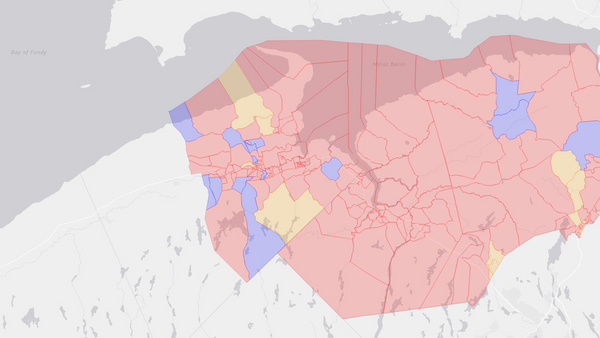
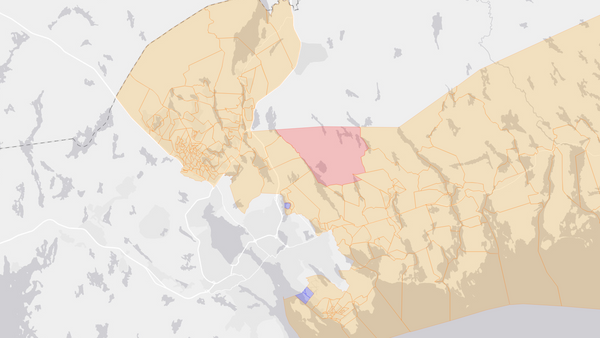
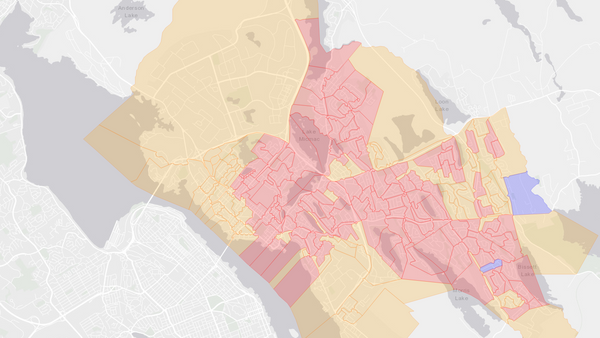
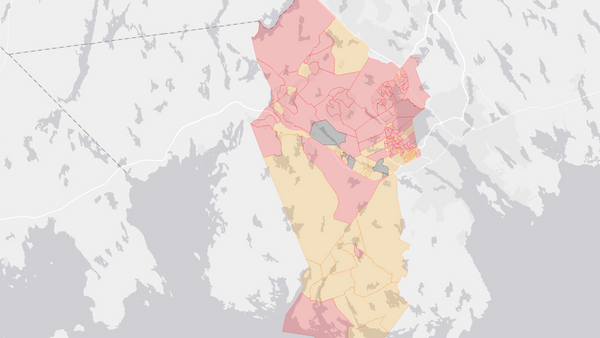
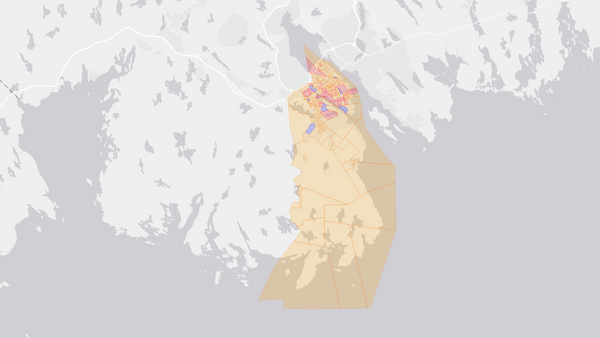
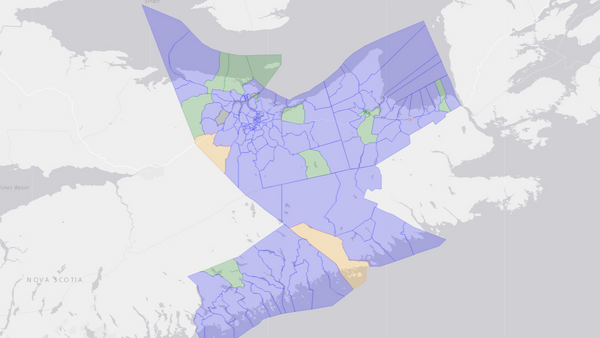
Cumberland—Colchester—Musquodoboit Valley, NS — 2008 Federal Election Results Map
Cumberland—Colchester—Musquodoboit Valley — 2008 Election Results
📌 The Canadian federal electoral district of Cumberland—Colchester—Musquodoboit Valley was contested in the 2008 election.
🏆 Bill Casey, the Independent candidate, won the riding with 27,303 votes (69.0% of the vote).
🥈 The runner-up was Karen Olsson (NDP-New Democratic Party) with 4,874 votes (12.3%), defeated by a margin of 22,429 votes.
📊 Other notable candidates: Joel E. Bernard (Conservative, 9%) and Tracy Parsons (Liberal, 8%).
Riding information
Auto generated. Flag an issue.Cumberland—Colchester—Musquodoboit Valley
No Nova Scotia riding entered the 2008 campaign in a stranger position. Its member had been thrown out of the governing caucus, renominated by his own riding association, refused the party's signature, and was running anyway. The constituency reaches across northern Nova Scotia from the Isthmus of Chignecto at the New Brunswick line, through Cumberland and Colchester counties, and inland to the Musquodoboit Valley at the eastern edge of the Halifax Regional Municipality.
Candidates
Bill Casey (Independent) — Casey first won Cumberland—Colchester in 1988 as a Progressive Conservative, lost it in 1993, took it back in 1997 and held it through three further elections. On 5 June 2007 he voted against his own government's budget, saying it broke the Atlantic Accord on offshore revenues, and was expelled from the Conservative caucus for it. That October the local Conservative association renominated him; the party's national office refused to accept the nomination and suspended the association's board, leaving Casey to seek re-election as an Independent. Danny Williams, the Newfoundland and Labrador premier then conducting his own quarrel with Ottawa over the accords, said he would come to Nova Scotia to campaign for him. In early September the Green Party announced that it would back Casey rather than field a candidate against him.
Karen Olsson (NDP) — Olsson, of North River outside Truro, carried the New Democratic nomination.
Joel E. Bernard (Conservative) — Bernard, a senior public safety policy adviser who lived at Orléans, Ontario, defended the party's colours against the member it had expelled.
Tracy Parsons (Liberal) — Parsons, a sales vice-president from Bible Hill, was the Liberal candidate.
Rick Simpson of Springhill, who had also run here as an Independent in 2006, appeared on the ballot a second time.
About the Riding
Just under 88,000 people were counted in 2006, spread across nearly 8,000 square kilometres, and the economy runs on food, fibre and freight. Truro, the largest town with about 12,000 residents, sits where the Trans-Canada Highway meets the road to Halifax; the knitwear maker Stanfield's has worked there since Charles Stanfield opened a woollen mill in the town in 1870. Amherst, the western anchor, keeps a manufacturing base that includes IMP's aerospace components plant and the flexible-packaging maker Emmerson Packaging. At Oxford, Oxford Frozen Foods — the world's largest grower and processor of wild blueberries — is among Cumberland County's biggest employers, drawing on barrens that run across the county line into New Brunswick.
The old coal towns tell the harder half of the story. Springhill's mines shut after the 1958 disaster and the town has been shrinking ever since; the federal medium-security institution opened there in 1967, chosen as a deliberate act of economic replacement, is now among the steadiest sources of work. Three months before the election, on 7 July 2008, the fossil-bearing sea cliffs at Joggins were added to the UNESCO World Heritage List for their Carboniferous record — rare good news for a shoreline otherwise defined by pit closures.
Elsewhere the riding lives on agriculture, forestry and the tides. Dairy and beef farms line the Cobequid and Wallace valleys, sawmills work the Musquodoboit Valley around Middle Musquodoboit and Elderbank, and the Fundy shore at Parrsboro, Economy and Advocate draws visitors to some of the highest tides on earth. Pugwash and Tatamagouche face the warmer Northumberland Strait, and the Cobequid Pass toll highway carries through traffic between the Maritimes. The Nova Scotia Agricultural College at Bible Hill and the regional hospital at Truro round out the institutional base.
The Atlantic Accord dispute overshadowed everything else. It had cost the riding its place in the government caucus and it framed the sitting member's independent candidacy. Manufacturing employment, farm incomes and the future of the coal towns filled out the rest of the local argument.