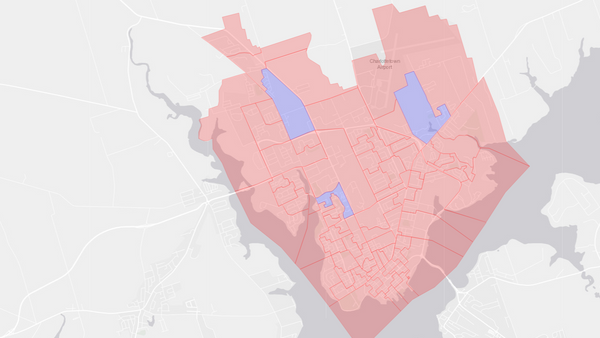
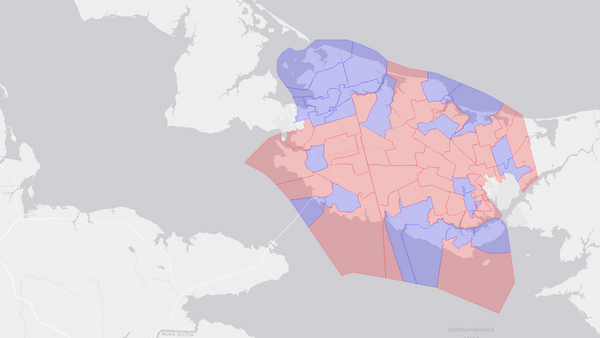
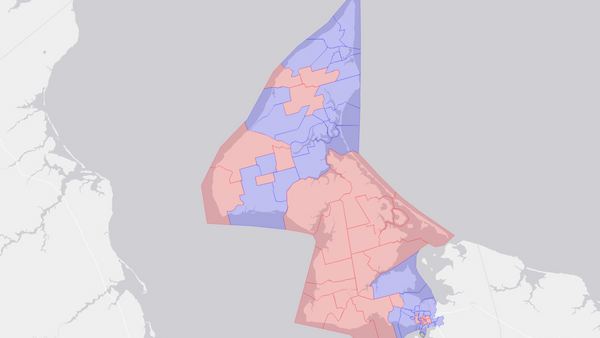
Cardigan, PE — 2008 Federal Election Results Map
Cardigan — 2008 Election Results
📌 The Canadian federal electoral district of Cardigan was contested in the 2008 election.
🏆 Lawrence MacAulay, the Liberal candidate, won the riding with 10,105 votes (52.8% of the vote).
🥈 The runner-up was Sid McMullin (Conservative) with 5,661 votes (29.6%), defeated by a margin of 4,444 votes.
📊 Other notable candidates: Mike Avery (NDP-New Democratic Party, 8%) and Larry McGuire (Independent, 6%).
Riding information
Auto generated. Flag an issue.Cardigan
Cardigan takes in the eastern third of Prince Edward Island — all of Kings County and the eastern edge of Queens. It runs from Stratford on the Hillsborough River out to East Point, along the north shore from Tracadie and the Stanhope and Dalvay end of the national park around St. Peters Bay, and down the south side through Belfast and Wood Islands to Murray Harbour. It is the most rural of the province's four districts, a landscape of red-soil farms and small harbours holding fewer than 40,000 people.
Candidates
Lawrence MacAulay (Liberal) — MacAulay had held Cardigan since 21 November 1988, when he unseated the sitting member, Pat Binns. Born at St. Peters Bay on 9 September 1946 and a farmer at Midgell, he served Jean Chrétien as Secretary of State for Veterans and for the Atlantic Canada Opportunities Agency, became Minister of Labour and minister responsible for Prince Edward Island on 11 June 1997, and was Solicitor General of Canada from November 1998 until he left cabinet in October 2002 during a conflict-of-interest inquiry. In opposition after 2006 he was the Liberal critic for seniors. He was seeking a seventh consecutive term.
Sid McMullin (Conservative) — McMullin was a human resources officer from Georgetown, on the riding's eastern shore.
Mike Avery (NDP) — Avery was a maintenance worker from Millview.
Larry McGuire (Independent) — McGuire, a retired teacher from Morell, ran without a party label.
Emma Daughton (Green) — Daughton, a student from Mermaid, carried the Green Party's banner.
About the Riding
Two industries set the rhythm of eastern Prince Edward Island: potatoes and lobster. Kings County farms supply seed and table stock to the Island's packers and processors, and the spring lobster season sustains wharves at Souris, North Lake, Georgetown, Cardigan and Murray Harbour. Mussel leases in the sheltered bays had grown into a substantial aquaculture sector. Both employ people for part of the year, which makes employment insurance rules a permanent federal subject here, and both were exposed to the credit freeze and falling export demand that arrived during the campaign itself.
Stratford, with 7,083 residents in 2006, is by far the riding's largest community and its least typical. Bunbury, Cross Roads, Keppoch-Kinlock and Southport amalgamated to form it on 1 April 1995, and it has functioned since as a commuter suburb of Charlottetown across the Hillsborough bridge. Montague (1,802) is the commercial and administrative centre for the southeast: supermarkets, hardware stores, dealerships and banks, Kings County Memorial Hospital, provincial offices including the Provincial Addictions Centre, the Mariner Seafoods plant, and the Eastern Graphic, the weekly that covers eastern Kings.
Souris (1,232) sits at the northeastern end with a working harbour and the terminal for the ferry to Quebec's Magdalen Islands. Georgetown (634) is smaller still but has one of the Island's deepest natural harbours at nearly eleven metres. The East Isle Shipyard there, owned by J.D. Irving and known for its tugboats, was the only shipyard on the Island; on 5 September 2008, days before the election was called, Ottawa committed $12 million toward seven tugboats to be built at the yard. The announcement landed in a town still absorbing the loss of the neighbouring Georgetown Timber sawmill, the largest on the Island and also Irving-owned, shut down in 2007 with 33 jobs as the American housing market fell away.
At the southern end of the riding, Wood Islands is the terminal for the seasonal crossing to Caribou, Nova Scotia, and tourism along the north shore beaches added a summer layer to an economy that otherwise runs on farming and fishing.