This week I had the pleasure of attending a lecture by the Rt. Hon. Joe Clark, the 16th Prime Minister of Canada, at Queen’s University.
Joe Clark is currently a visiting professor at American University and he stopped by the policy studies building at Queen’s on Monday to talk with students, professors and Kingstonians about “Reviving Canada’s International Vocation”.
The reverberating theme of Mr. Clark’s lecture was not only does the world need more Canada, but Canada needs more of the world.
The former Progressive Conservative Prime Minister asserted that our national sovereignty is in decline due to the erosion of our international purpose.
Further, he said that we need international issues to unite us and we need to look for our own identification in international foreign policy.
Clark made it clear though that our foreign policy must not be dictated by our trade relations with the United States. He warned of our mercantile interests over diplomacy; our government cannot place higher concern with our economic interests over our diplomatic obligations. However, he said that our international role must be regained because, as Canadians, we used to have the authority to council and advise the American administration as a friend. Clark described that the Chrétien government did much harm to this ability and now it must be to Paul Martin or his successor to lead Canada in a greater international role. Further, Clark asserted that Canada has not completely lost its ability to retain its authority as a friendly advisor to the United States concerning that country’s foreign policy.
Afterall, Clark remarked, it was Canada that was an originator of the U.N., of NATO and it was Canada that had a lead role in the international anti-personnel landmine treaty.
However, in the wake of drastic cuts to military funding and humanitarian spending, Canada has left its international responsibilities and therefore our international importance is fading.
In his wise and always eloquent delivery, Mr. Clark summarized his lecture by saying that what we did in the world reflected who we were at home.
I found Joe Clark to be particularly admirable in his assertion that essentially, we must do what’s right instead of doing what is always right for us. In the end, I suppose, what is right will be what is right for us.
I had the opportunity to ask Mr. Clark for his response to clarify the irony of his departure from the Conservative party. I asked him that given the dynamic nature of political parties (Sir John A. MacDonald’s conservatives were against free trade for example), whether he believes that John A. MacDonald’s Conservative party is solely different or truly non-existent (given Mulroney’s drafting of NAFTA on one hand, and given the merger with the Canadian Alliance on the other). Further, I asked, as a result of this fluidity of party positioning why he would leave a party, in its formative stages in which his voice would have had a great influence, when the ironic effect of his departure would shift the party towards a policy stance of which he would have preferred to prevent.
He granted the reality of the shifting and reconfiguring of the policies of political parties throughout Canadian history, however, he said that he currently could not sit with the current Conservatives and that it was his time to leave politics.
Personally, I found Joe Clark to be quite amicable and humble and, in the future, I would jump at any opportunity to have further conversations with the former Prime Minister on any variety of political topics.
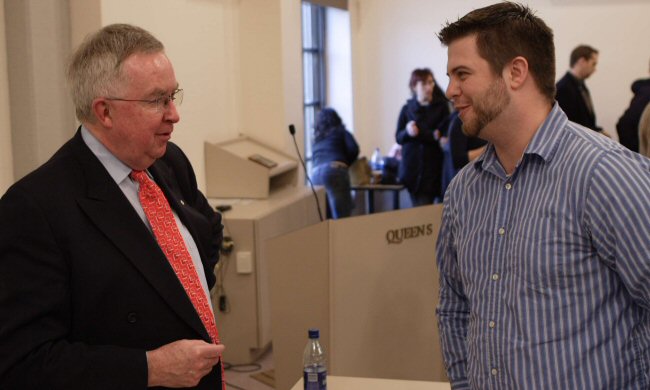
With Joe Clark – Click to Enlarge