I thought musicians were supposed to be original

Look over there, it’s another artist railing against George W Bush and the establishment. Yawn.

According to the UK’s Independent:

Could Neil Young, a cultural lodestone for a generation of country rock fans, really be turning his attention to President George Bush and the war in Iraq? Now Young himself has confirmed it. Not only has he recorded an entire album about the conflict, but in one of the songs he spells out who he thinks is to blame for the ongoing chaos and violence and what the consequences for that person should be. That track is called “Impeach the President”.

I attended a few shows last year including K-os and Billy Talent. During these shows, the crowd was subjected to political lectures of the leftist persuasion. Each artist is entitled to his or her view, however, I always found it somewhat ironic for Canadian musicians to their message to us on the issue of George W Bush. As Canadians, we certainly can’t vote Democrat and I’m certainly not going to take political advice from the likes of K-os (the socialist “revolutionary” who is laughing all the way to the bank).

I enjoy a good show, but I often have to stand through the obligatory and ironic two minute rant about how capitalism and excess are damning our society and how that, to my surprise, war is “bad” (well, thanks… I understand now). Political activism by musicians against the establishment always seemed disingenuous to me and I have often laughed at the imaginary prospect that a punk band might one day address the crowd between songs:

“S%*t, we’ve got something to say about George f@%*ing W Bush! … Stay the course! Make the tax-cut permanent!”

We’ve seen rants against the establishment conservatives in Canada as well (yet, the Liberals were the establishment for 12 years). During previous election campaigns, we’ve seen artists such as Avril Lavigne and Sam Roberts join the campaign to “Stop Harper”. In fact, I caught Roberts’ drunken show on Parliament Hill last year as he dropped the subtext and just went for it as he lectured the crowd by song with a track called “Socialism”. Being a rebel has always had a certain romance to it, however, when the establishment is Liberal and the rant unoriginal, there lacks a certain political cogency. Moreover, Canadian musicians ranting against the American conservative establishment are rebels without a constituency and are rather rebels on the sell.

Anyways, Neil Young’s hardly shocking unoriginal pronouncement reminded me of an article that was written in 2004. Currently unavailable online and originally submitted as a blog post on FatPipeRadio.com the article is still relevant for today’s music industry, which should be desperately seeking originality. The article was written by punk-enthusiast and current Minister of Health Tony Clement, whom is much more versed in the world of punk music than me:

Like the return of flare pants or narrow ties, once every few years rock n’ roll aspires to be overtly political in a big way. All around us, musicians are demanding “fair trade” (Coldplay concerts regularly distribute brochures and advertise website destinations), urging foreign debt relief (Bono being the most prominent advocate) or illuminating the teachings of the Dalai Lama as they inform us of the current state of Tibetan-Chinese relations (Adam Yauch and the Beastie Boys).

Indeed, this kind of political advocacy is not new. From Bob Dylan’s folk songs, themselves following in the footsteps of Woody Guthrie’s depictions of the downtrodden, to Bob Geldof’s Live Aid efforts in the 1980s, rock n’ roll and social conscience have mixed quite well, thank you. That is the way it should be. Rock as a musical form has always been about breaking social and political conventions. Its birth was as a direct result of black and white fraternization. Established society considered it lascivious “Negro music”, which only heightened its allure for young people in the 1950s, and guaranteed its popularity among white suburbia. When Jack Black’s character lectures the school kids about standing up to “the Man” in the movie “School of Rock”, it was and is the truth.

Today, the biggest growth industry for protest is, of course, George W. Bush. Here, the entire entertainment industry has something to say. After the shock of 9/11, much of popular culture was silent. Soon, however, artists found their voices. Bruce Springsteen’s haunting “The Rising” is a fine example of post-9/11 mourning and reflection. Wilco’s “Yankee Hotel Foxtrot”, although conceived prior to the terrorist attacks, has lyrics and themes that evoke as well.

This year, however, most of the commentary has a more direct target: George W. Bush. Compilations like “Rock Against Bush” are getting shelf space. Thoughtful groups like Radiohead are getting into the act. And you know a cause is a cause when Moby wants to add his two cents’ worth. The Democrats’ Presidential nominee, John Kerry, is using rock n’ roll to maximum effect. He has held several fundraisers, raising $10 million at a time, featuring stars as varied as Barbra Streisand, Neil Diamond, Mary J. Blige and Jon Bon Jovi. And so on and on.

Do I have a beef with this? Yes and no. No, in the sense that this is business as usual for rock, as described already in this column. It is, I believe, the business of rock to challenge beliefs and attack establishment figures. But yes, because there is something wrong with this picture. For some time I just couldn’t put my finger on it. I knew it had nothing to do with the political bent. If you like rock, be it pop, punk or folky, you get used to the left-of-centre bias. It comes with the territory. Here’s the issue: to me, it is the establishment position of Hollywood, and the entertainment industry in America generally, to be clearly anti-Iraq war and anti-Bush. That’s the consensus. The jury is in and the verdict is unequivocal: artists and entertainers want Bush out.

So, as an artist, as a rock n’ roller who wants to make a statement, how hard is it to agree with the anti-Bush side? It’s what practically everyone, except a few rockers like Kid Rock, are saying, singing and writing right now. Anti-Bush: how predictable. How mainstream! I almost have more time for the iconoclastic few that defy this consensus. Is Kid Rock more of a rebel than Michael Stipe, just by daring to back American troops in Iraq? Closer to home, are Billy Talent just aping an unthinking consensus when they cheered the defeat of Stephen Harper, as they did unabashedly at Toronto’s Edgefest just after the June 28 federal election?

By having such a consensus position, rock artists do themselves a disservice. I suspect that they end up preaching to the converted, rather than swaying public opinion. Polls in the United States back this up: even “Fahrenheit 9/11”, a huge commercial success, is making no ripple in the US presidential race because its polemics do not sway undecided voters, the Holy Grail of the campaign.

So what’s my suggestion? Merely this: if rock n’ roll artists want to be truly relevant on issues like Iraq, Bush and war, be more diverse in the opinions that are offered to the audience. Don’t be monochromatic. Have different views. Have a real debate. Rock out with Bush, not just against Bush! If that’s simply too much to ask, be more welcoming of other opinions, within the audience and throughout society as a whole. As Green Day is singing about these days in “American Idiot”, censorship is the key vice to avoid, even if the censorship comes from the oppression of groupthink.

In the meantime, enjoy the music–and think for yourself!
Shameful question of the day

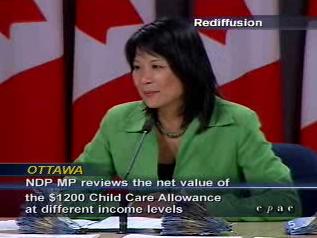
NDP Youth and Families critic Olivia Chow held a press conference yesterday to outline her party’s position that the Conservative $1200 daycare allowance should instead be offered as a tax credit.

Elizabeth Thompson of the Montreal Gazette is introduced by the press theatre moderator and she first contrasts “working mothers” with stay-at-home moms and the differences in benefits each would receive under the Conservative plan.

Thompson, not getting the answer she wanted instead prompts Chow:

“A stay at home mom doesn’t have any income of her own, outside of the $1200. I guess the point that I’m trying to get: to what extent does this system, sort of, perhaps encourage women to stay at home with their kids, which is something some elements of the Conservative Party tends to advocate?

Chow chuckled off the sexist question and to her credit did not give Thompson the point that she was trying to get: that the Conservative Party advocates that a woman’s place is at home with her children.

Of course, this is not the Conservative position as the Conservative plan is not explicit about stay-at-home moms or stay-at-home dads. The factor outlined in the plan is income (which in fact was the point of Chow’s presser).

Unfortunately, some reporters have deeply held biases. A reporter should never allow these biases to affect their work. Here we see Thompson’s bias against women (as the default stay-at-home parent) and against Conservatives (as sexists). (see the update)

chow-daycare-press-sexism.JPG
Watch the video of Thompson’s question

(Firefox users, right click and save as…)

UPDATE: Elizabeth Thompson responds in the comments: “Those who know the media and how it works know you should never mistake a reporter testing to see just how far someone’s position goes (and just how much of that rope they may want to use to hang themselves) with the reporter’s personal views. The question I asked jibed with the views of many NDP supporters and was the logical extension of what she was suggesting – I just wanted to see whether Olivia Chow was prepared to go that far.

“As for the dispute with the press gallery – fewer press conferences means less to distract us from finding out and reporting what a government is really up to. I just wonder how long it is going to be before the people who dreamed up the strategy realize they are actually in the process of losing control of the agenda.”

Fair enough. I guess I’m still getting to know the media. Was Ms. Thompson baiting Chow? Perhaps. I’m not willing to withdraw my assertion that some reporters have deeply held biases, but I will give Thompson credit for providing a logical response and will give her the benefit of the doubt.

In cases such as these, reporters’ questions only go on the record if the person questioned makes the error of taking the bait. As a result, it is the politician that is held responsible rather than the reporter. Granted, if Ms. Chow had latched onto the question, this post would have been about her instead. My apologies to Ms. Thompson for accusing her of bias on this exchange with Chow.

Now, the second half of Thompson’s response is interesting as well: the limited number of press conferences (or PPG accessibility to cabinet) will actually damn Harper’s camp because reporters will have more time on their hands to dig up the real answers? That’s the first time I’ve heard of this angle on the issue and Thompson is likely in the minority POV in the PPG on this. It will be interesting to see if it does indeed play out this way. Will Harper’s communications team’s attempt at order lead to disorder? The strategy is keep discipline among cabinet ministers (so that they aren’t hanged by the rope that the media is so willing to provide) so I’m not convinced. The PPG may have more time to ask staffers, opposition MPs and “anonymous sources” more questions, but keeping discipline among the high level credible sources is an understandable facet of the PMO’s self-preservation strategy.

News of FAA obfuscated by CBC grumbling

It was certainly a banner day for Stephen Harper’s new Conservative government. Today, the centrepiece legislation (essentially the foreseeable legacy of this new government) was tabled in the House of Commons by Minister John Baird, the President of the Treasury Board.

However, this anticipated legislation, which is unequivocally at the centre of Stephen Harper’s mandate in Parliament, was overshadowed in the following CBC clip (linked below) by sarcasm and anger at PMO communications by CBC reporter Keith Boag.

(UPDATE: The first 1:08 minutes of) Keith Boag’s report on the Federal Accountability Act the media’s frustration
(Firefox users, right click and save as…)

The clip is marked with numbers which refer to the notes below:

  1. Keith Boag remarks (or complains) that Stephen Harper made them “jam” into a small room for a press conference. (Perhaps a larger venue such as the lobby outside of the HoC would be more appropriate for large crowds of reporters and their technical crews? However, I hear that reporters would prefer to “jam” themselves in the narrow hallway outside of the Prime Minister’s office and cabinet meeting room)
  2. More than 300 clauses in the FAA? Not bad. Too bad the FAA’s merits do not strike Boag enough to underscore them first in his report. This report instead begins with his anger towards cabinet accessibility.
  3. “Reporters had dozens of questions about [the FAA]”, Boag remarks as he sets up the video which includes an irate reporter complaining, “Are you going to ignore everyone (the queued reporters) in the lineup?”. Boag then edits to qualify the reporter by explaining that Harper only allowed one question in each official language. CBC’s chief political correspondent continues sarcastically, “Then he left, to champion public accountability, transparency and openness elsewhere.”

It’s always interesting when reporters make themselves the topic of the news. Stephen Harper and his communications team have done their best to control messaging and the PMO’s position (that is, after all, what a communications team gets paid for). So, as we see with Keith Boag’s report, the battle continues between the PMO and the PPG. A couple of sincere questions that I ask are: How much access to the PM and cabinet are reporters entitled to? Does the PM allow/deny access for his own benefit/peril?

In this modern era of 24 hour cable news, reporters are certainly under more pressure to get the report filed quickly (and often live) and get it with full picture, sound and comment.

The Prime Minster’s office, in contrast, is not under the same pressures and really hasn’t changed to a significant degree in its need to satiate the media since print reporters that made telephone calls for comment were the primary report filers. Modern media demands the sound bite and live video and these demands are at odds with a body (the PMO) that’s strategy has never really changed: control messaging and information flow.

If I found myself in Ottawa as a reporter for the modern news industry I would very rightly be frustrated with Stephen Harper’s communications approach that finds itself directly incongruent with the demands of my job. However, I don’t believe that I’d be justified in laying blame on the PMO for its strategy. Overall, the media’s gripe, however, is not an issue of accountability upon which the Conservatives campaigned (and subsequently received a mandate). Stephen Harper is not accountable to the Keith Boag (as a reporter) by any legal or constitutional measure. Boag may certainly vote against the Conservatives when the next election is held, but Harper’s communications strategy is certainly not part of any accountability requirement in the context of the Federal Accountability Act.

Many of those that watch Ottawa will remember the days of Jean Chretien when the former PM went on a golf vacation. The PMO would only tell the press gallery that their boss was on “personal business”.

Boag tries to link the frustrations of his job with “government accountability”. Canadians voted for change in the way that government contracts are awarded, lobbying is conducted, and the way that whistleblowers are protected. They voted for accountability in the way government works. Canadians did not vote for the Boag’s easy access to the most sought-after video and sound bite.

UPDATE: For the sake of clarity for some readers out there, I agree that the PPG/Boag certainly has the right to be frustrated. However, facile and on-demand media access is not an issue of government accountability (in the context of the FAA, or the election/mandate that was fought/received on the issue). My complaint is that it was selfish for Boag to complain about his frustration when it was unrelated to the story.

UPDATE (bonus video): The CBC scores again for biased reporting on the same night. Check out the clip below which is from a report about Access to Information:

CBC reports on Access to Information
(Firefox users, right click and save as…)

“Ottawa may not be a ‘culture of entitlement’ as the Conservatives claim. But it is a culture of secrecy.”

Err… wasn’t it Justice Gomery that called Ottawa a “culture of entitlement”.

Yes it was

Seriously… come on CBC. I just reality checked your “Reality Check”.

By the way, Crown Corporations (including the CBC) will be subject to reformed (and stricter) Access to Information legislation tabled by the Conservative government.

UPDATE: Much to my surprise (and likely hers as well), Zerb agrees with me.

UPDATE: Well, that was short-lived and too good to be true. Apparently Zerb misinterpreted the video and thought that the clip represented the entire report (even though it doesn’t end with “Keith Boag, CBC. Ottawa”) She focuses on her misinterpretation rather than in the fault that lies with the state-run media.