Non-binding motions: the end-run around Parliament

Billions of dollars have been spent, entire bureaucracies created, and major policy directions set in Canada — all without Parliament passing a single law to authorize any of it. The vehicle is the non-binding motion: a parliamentary declaration of opinion that carries no legal force and compels no action. The House of Commons Procedure and Practice manual is clear on this, and every parliamentarian is told as much when they arrive on the Hill. The same applies to most United Nations General Assembly resolutions — everything below the Security Council is aspirational. Collective intent, not law.
Non-binding motions and international declarations have become an end-run around Parliament, allowing governments and bureaucracies to build policy, spend money, and create institutions without the accountability that legislation demands. If a policy objective is worth pursuing, it should go through the legislative process — first reading, committee study, public debate, amendment, and a vote on a binding legal text. If it cannot survive that scrutiny, Canadians deserve to know before billions are committed in their name.
How Ottawa turns symbolic votes into policy without legislation
The pathway from non-binding motion to implemented policy follows the same institutional chain in Canada, case after case:
For deeper analysis and exclusive posts, subscribe to my Substack.
- A non-binding motion passes the House of Commons, or Canada endorses a non-binding international instrument
- A parliamentary committee is tasked with studying the subject
- The committee produces a report with recommendations
- The government responds within 120 days, accepting recommendations in principle
- Subsequent federal budgets allocate funding for new programs or offices
- Departmental reorganization creates secretariats within existing structures
- Governor in Council appointments fill newly created positions
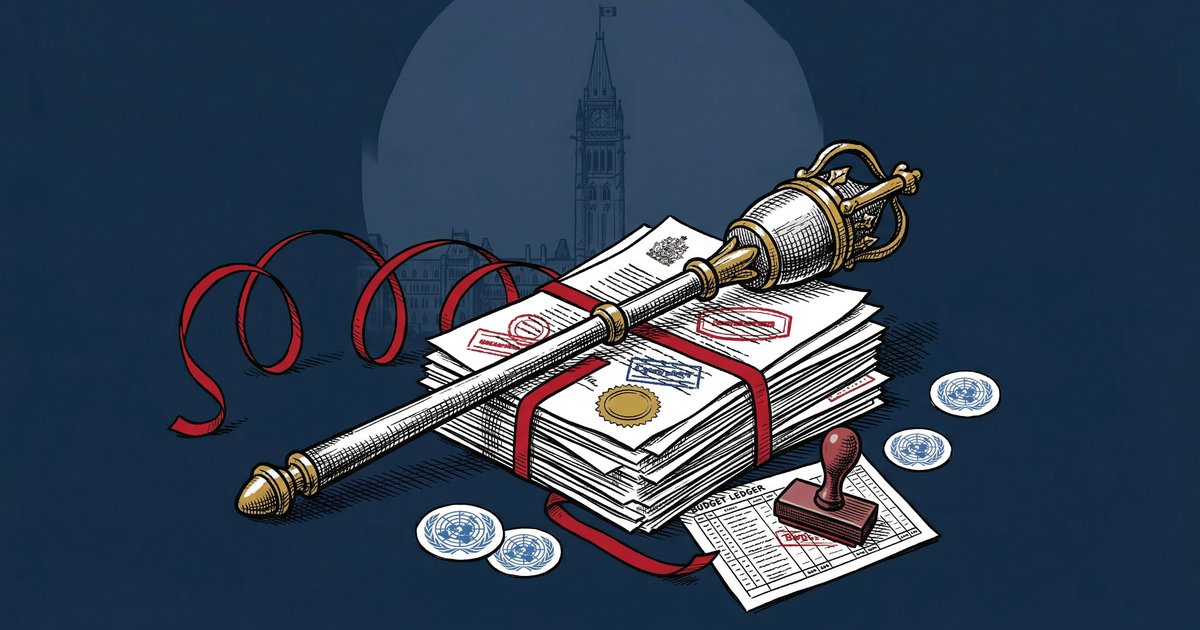
At no point does anyone pass a law. The money comes from the general appropriations process — the Main Estimates and Supplementary Estimates that Parliament approves as a package, often with minimal scrutiny. The authority to reorganize departments comes from the Crown's prerogative over the public service. The motion itself just provides political permission and political cover for the bureaucracy to act.
The government's own Guide to Making Federal Acts and Regulations says so openly: legislation is "just one of several ways of achieving governmental policy objectives." And the Privy Council Office's guidelines on government responses to committee reports note that such responses "do not typically include seeking authorities for new policies or programs." In other words, the government has told itself it doesn't need Parliament's permission. The budget process funds the programs anyway.
How M-103 built a $45 million bureaucracy without a single law
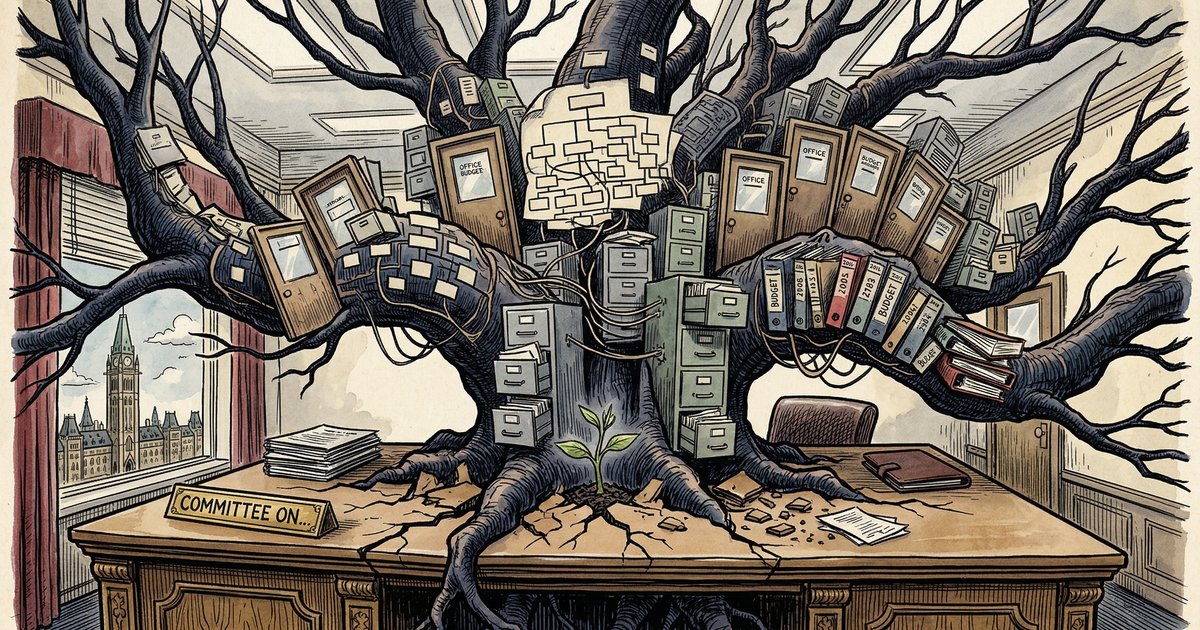
Motion M-103, introduced by Liberal MP Iqra Khalid, passed 201-91 on March 23, 2017. It called on the government to condemn Islamophobia and asked the Standing Committee on Canadian Heritage to study how racism and religious discrimination could be reduced. On its face, an expression of values.
Look at what grew from it.
The Heritage Committee produced 30 recommendations in February 2018. The government responded with "Building a Foundation for Change: Canada's Anti-Racism Strategy 2019-2022" — $45 million in spending that included $4.6 million to establish a new Anti-Racism Secretariat within the Department of Canadian Heritage and $30 million in community-based projects. The Secretariat was created through the budget process and departmental reorganization. No dedicated legislation was introduced.
A National Summit on Islamophobia followed in July 2021. January 29 was proclaimed by Order in Council as a National Day of Remembrance. In January 2023, the Prime Minister appointed a Special Representative on Combatting Islamophobia with a $5.6 million budget over five years. The Anti-Racism Strategy was renewed through 2028, now housed within Employment and Social Development Canada.
Trace the lineage: a non-binding motion became a committee study, which became committee recommendations, which became a budget allocation, which became a permanent secretariat, which became a Governor in Council appointment of a special representative. Nobody passed a law for any of it.
The broader anti-racism apparatus grew in a direction that gave the Trudeau government tools to frame political opponents through the lens of racism and extremism — importing the American culture war into Canadian parliamentary discourse. Trudeau himself accused Conservative MPs of standing with "people who wave swastikas" during a 2022 House of Commons debate on the trucker convoy, a smear that was widely condemned. A bureaucracy nominally built to combat hatred had become more useful for partisan combat than for protecting anyone. And after October 7, 2023, it faced its real test and failed. Hate crimes surged to record levels despite the $45 million strategy, the secretariat, and the Special Representative. Jewish day schools in Montreal and Toronto were hit by gunfire. Congregation Beth Tikvah in Montreal was firebombed twice — in November 2023 and again in December 2024. B'nai Brith Canada's annual audit recorded 6,219 antisemitic incidents in 2024, roughly 17 per day, a 125 percent increase from 2022. The government was vocal about antisemitism on the right but far quieter about antisemitism emanating from the left. And while Jewish schools were being shot at and synagogues firebombed, that same Parliament passed another non-binding motion — this time to embargo arms to the Jewish state. The hypocrisy is difficult to overstate: the government used a "non-binding" motion to build a $45 million anti-racism bureaucracy, while another "non-binding" motion singled out the world's only Jewish state for an arms embargo — while Jews at home were under physical attack.
The Carney government abolished the Special Representative position in February 2026. But the institutional architecture built from a non-binding motion — the secretariat, the strategy, the funding streams, the programming — persists.
Non-binding motions that changed Canadian policy without legislation
M-103 is the most thoroughly documented case, but the pattern recurs across the political spectrum.
Yazidi refugees (2016). Conservative MP Michelle Rempel's opposition day motion, unanimously adopted on October 25, 2016, recognized ISIS persecution of Yazidis as genocide and called on the government to provide protection within 120 days. Despite being non-binding, IRCC resettled over 1,400 survivors using existing departmental authority. The government expanded the initiative in 2021 for family reunification. No new legislation was required. This is a case where the motion addressed an urgent humanitarian crisis with broad bipartisan support, and the government acted within the scope of what Parliament expressed. It is worth noting as a contrast to the cases where motions generate sprawling bureaucratic mandates that far exceed what was voted on.
Arms exports to Israel (2024). An NDP opposition day motion passed 204-117 on March 18, 2024, calling on Canada to cease arms exports to Israel. This was a nakedly ideological motion on one of the most contentious foreign policy questions in the country, debated and voted on within a single sitting day. Foreign Affairs Minister Melanie Joly's initial response: "We can't change foreign policy based on an opposition motion." The government then did exactly that, pausing new permits and suspending roughly 30 existing ones through ministerial discretion. A non-binding opposition day motion effectively rewrote Canada's export policy toward a democratic ally without legislation, without committee study, and without the kind of serious foreign policy debate the subject demanded.
Quebecois nation (2006). Prime Minister Harper's motion, passed 265-16, declared that "the Quebecois form a nation within a united Canada." Harper stated it would not entitle Quebec to new powers or alter constitutional arrangements. Quebec subsequently cited the motion in connection with Bill 96 (2022), which unilaterally amended the provincial constitution to declare Quebecers a nation and French the sole official language.
Human trafficking (2007). MP Joy Smith's motion, passed unanimously, called for a national plan. Five years later, the National Action Plan to Combat Human Trafficking was established through executive policy — not legislation.
Climate emergency (2019). Passed 186-63 on June 17, 2019 — the day before the government approved the Trans Mountain pipeline expansion. The Centre for Constitutional Studies noted it did not invoke emergency powers and carried no legislative force. The declaration became part of the political backdrop for the Canadian Net-Zero Emissions Accountability Act.
There are counter-examples. The House voted 266-0 in 2021 to declare China's treatment of Uyghurs a genocide, with the entire cabinet absent for the vote. Motion M-62 called for resettling 10,000 Uyghurs. Neither was meaningfully implemented. The MMIWG emergency declaration of 2023 fared similarly — the Senate's own committee titled its report "Not Enough: All Words and No Action."
The counter-examples are revealing. Non-binding motions generate bureaucratic implementation when the governing party supports the motion's substance and when the executive has political reasons to act. The motions function as selective permission slips. They give the bureaucracy cover to act when the executive already wants the outcome.
How UN declarations become Canadian policy through the back door
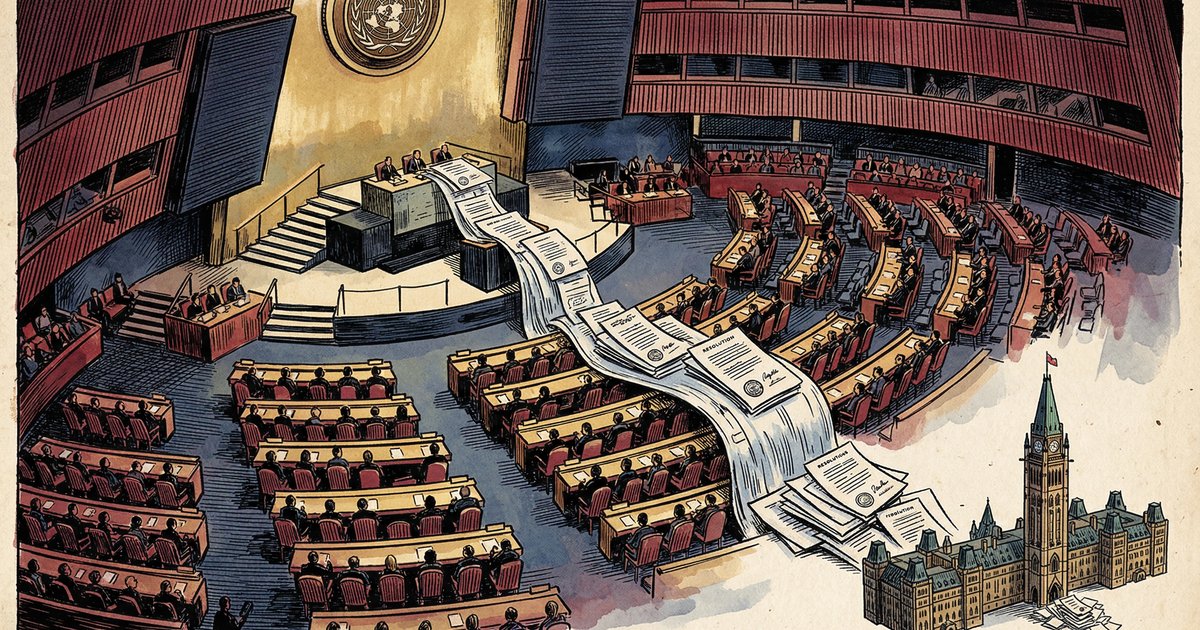
The same dynamic plays out on a larger scale through international instruments — but with an additional wrinkle. The norms baked into these instruments come from supranational bodies whose ideological orientation favors collectivist and interventionist governance. The UN system promotes frameworks that centralize authority, expand regulatory scope, and embed progressive social policy into administrative requirements. The domestic bureaucracies tasked with implementing them share much of that orientation.
The practical consequence: policy preferences that might never survive a vote in a national legislature can be adopted through the back door. They get endorsed at an international conference, embedded in a non-binding declaration, and implemented administratively by sympathetic bureaucracies — without ever facing a domestic legislative vote.
UNDRIP: Canada voted against it, then implemented it anyway
The UN Declaration on the Rights of Indigenous Peoples was adopted by the General Assembly in September 2007. Canada was one of four states that voted against it. The Conservative government reversed its position in November 2010, endorsing it as an "aspirational document." By 2016, Canada was a full supporter.
The declaration acquired domestic force one step at a time — most of them before any legislation was passed.
In July 2017, the government issued the "Principles Respecting the Government of Canada's Relationship with Indigenous Peoples" — ten principles rooted in both Section 35 of the Constitution and UNDRIP, issued by cabinet directive without legislation. These principles stated that "free, prior and informed consent builds on and goes beyond the legal duty to consult." They were used to guide all federal departments in reviewing their laws, policies, and practices.
The Impact Assessment Act (2019) incorporated UNDRIP concepts that went beyond existing constitutional law requirements established by the courts. Justice Minister Jody Wilson-Raybould had earlier acknowledged that direct implementation of UNDRIP was "unworkable" and proposed it would instead be "implemented over time through legislation, policy and action" — essentially through bureaucratic channels.
Bill C-15, the UNDRIP Act, received Royal Assent on June 21, 2021. Critically, it does not incorporate UNDRIP directly into Canadian law. It requires the government to ensure federal laws are "consistent with" the Declaration and to develop an action plan. The Action Plan, released in June 2023, contains 181 measures across 25+ departments — with few specific and measurable commitments and nearly no binding timelines. A Minnesota Journal of International Law article has questioned whether the Act is truly binding or merely an interpretive tool.
British Columbia enacted the Declaration on the Rights of Indigenous Peoples Act in 2019, going further than the federal government — the BC Court of Appeal confirmed it incorporates UNDRIP into provincial law with immediate legal effect.
Voted against, endorsed as aspirational, implemented by cabinet directive, partially legislated, expanded through an action plan with no enforcement. By the time Parliament got around to passing a law, the bureaucracy had already done the work. The legislation formalized what was already in place.
In British Columbia, where the NDP government went further than Ottawa with its own DRIPA legislation in 2019, the consequences are now playing out in real time. The August 2025 Cowichan decision saw the BC Supreme Court declare Aboriginal title over lands that include private fee-simple property, ruling that sections of the Land Title Act establishing those titles as "indefeasible" do not override Aboriginal title. The court explicitly cited BC's commitment to UNDRIP through DRIPA in its reasoning. A second claim on private lands followed shortly after. Premier Eby has since moved to amend DRIPA, scrapping language requiring that BC laws "must" be consistent with UNDRIP in favour of weaker "working toward" language — an acknowledgment that the original legislation had created consequences the government itself did not foresee. The BC Conservative leadership race, currently underway, has made DRIPA repeal a central issue — all seven candidates are calling for it. A non-binding UN declaration, adopted into provincial law, is now the dominant political question in British Columbia, with homeowners across the province uncertain about whether their property rights are secure.
The UN's Sustainable Development Goals cost Canadians $100 million — Parliament never authorized it
The 2030 Agenda for Sustainable Development, adopted by the UN General Assembly as Resolution 70/1 in September 2015, is non-binding. Canada's federal bureaucracy built an entire implementation architecture around it anyway.
Budget 2018 allocated $49.4 million over 13 years to establish an SDG Unit within Employment and Social Development Canada and fund Statistics Canada monitoring, plus an additional $59.8 million over 13 years for SDG programming. The SDG Funding Program alone distributed $11.3 million to 32 organizations in 2020-2021. SDGs were integrated into departmental plans and results reports across the federal government. In February 2021, the government launched "Moving Forward Together" — a whole-of-government strategy developed and released as executive policy without specific parliamentary debate or authorization.
The Commissioner of the Environment and Sustainable Development reported in April 2018 that the government was "not adequately prepared to implement the SDGs." No governance structure, no communication plan, no engagement strategy. The government went ahead anyway. The Federal Sustainable Development Act provides a general legislative framework, but the SDG-specific programming, funding, and bureaucratic structures were all created through budget allocations and executive action — Parliament never specifically authorized any of it.
GBA+: the policy framework Canadians never voted for
Gender-Based Analysis Plus is likely the most consequential policy framework that Canadians have never voted on. It traces its origins to the Fourth World Conference on Women in Beijing (1995) and to Canada's ratification of the Convention on the Elimination of All Forms of Discrimination against Women in 1981.
GBA+ was not legislated as a standalone requirement. The Canadian Gender Budgeting Act (2018) formalized gender budgeting in the federal fiscal process, but the broader GBA+ framework — its application across all Memoranda to Cabinet, regulatory proposals, and departmental operations — was an executive commitment flowing from participation in an international conference. But by 2018, it had become mandatory for all Memoranda to Cabinet, all budget requests, and all Treasury Board Submissions. The September 2018 Cabinet Directive on Regulation required GBA+ assessment of every regulatory proposal. The Gender Results Framework introduced in Budget 2018 explicitly builds on CEDAW and the Beijing Declaration.
Every piece of federal legislation, every regulation, every budget item is now filtered through a framework that originated in an international declaration and was never authorized by Parliament. Most public servants treat it as a given — they have never known a federal government that didn't require it. That is what norm internalization looks like in practice.
The Global Compact on Migration and other UN frameworks Ottawa adopted without debate
The Global Compact for Migration, adopted in December 2018, is explicitly non-binding. When Conservative MP Michelle Rempel moved that the Standing Committee on Citizenship and Immigration study the Compact before Canada signed, the timeline was too compressed for meaningful review. An Oxford Academic study later concluded that Canada used the Compact to advance existing bureaucratic objectives — the Compact provided international legitimacy for actions the bureaucracy was already pursuing.
The UN International Decade for People of African Descent (UNGA Resolution 68/237) led the Federal Anti-Racism Secretariat to apply a "Black-centric lens to the policymaking process" in partnership with ESDC — no enabling legislation.
Canada's tri-agency research councils (CIHR, NSERC, SSHRC) implemented equity, diversity, and inclusion requirements for research funding — including the Dimensions charter and pilot program for postsecondary institutions — through administrative policy rather than legislation. These requirements condition tens of billions in research funding on institutional DEI commitments adopted as bureaucratic best practices aligned with international frameworks.
The Continuing Committee of Officials on Human Rights, established in 1975, has operated for decades as a "behind-closed-doors, information-sharing forum" coordinating federal-provincial-territorial implementation of international human rights recommendations — essentially a bureaucratic mechanism for implementing international instruments without legislative scrutiny.
The Auditor General found $9 billion in spending with no minister to answer for it
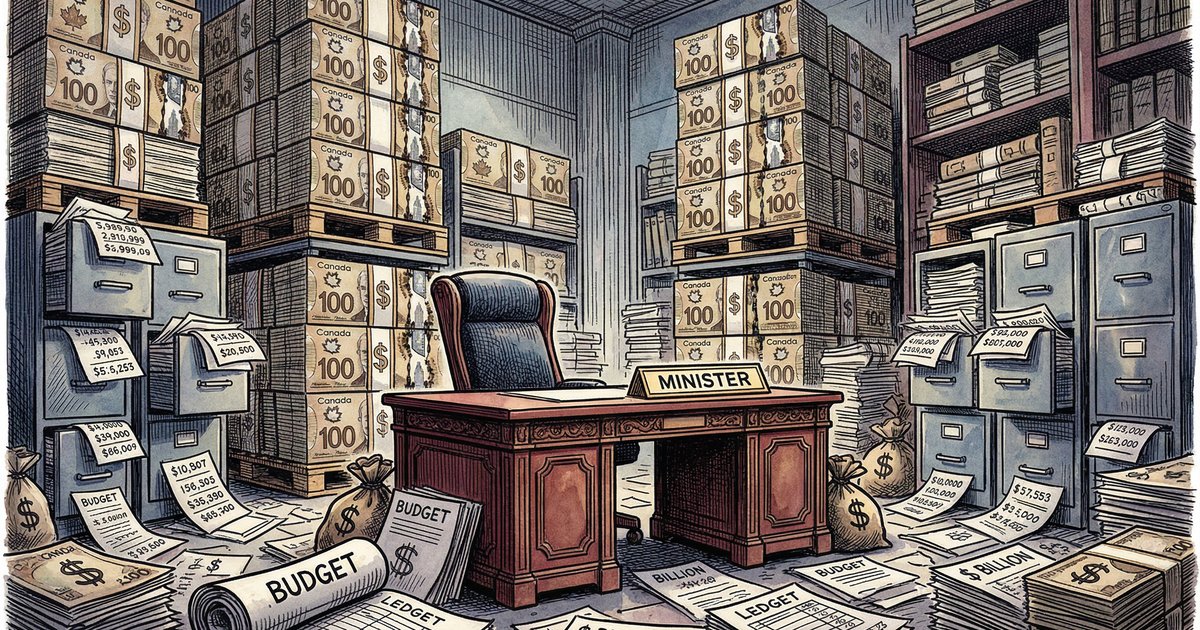
The 2006 Auditor General's report, "Government Decisions Limited Parliament's Control of Public Spending," documented how more than $9 billion had been transferred to foundations since 1997 — non-profit corporations carrying out government programs that were not accountable to Parliament through a minister.
These foundations received public money and delivered public programs, but no minister was responsible for them. No auditor had the authority to examine them. They sat outside parliamentary scrutiny entirely — spending billions with no democratic accountability.
The vehicle differs from case to case — a non-binding motion, an international declaration, a transfer to a foundation — but the effect is the same. Public money is spent and public policy is made through channels that bypass the institution Canadians elect to exercise those powers. The money flows. Parliament is informed after the fact, if at all.
How international norms capture domestic bureaucracies
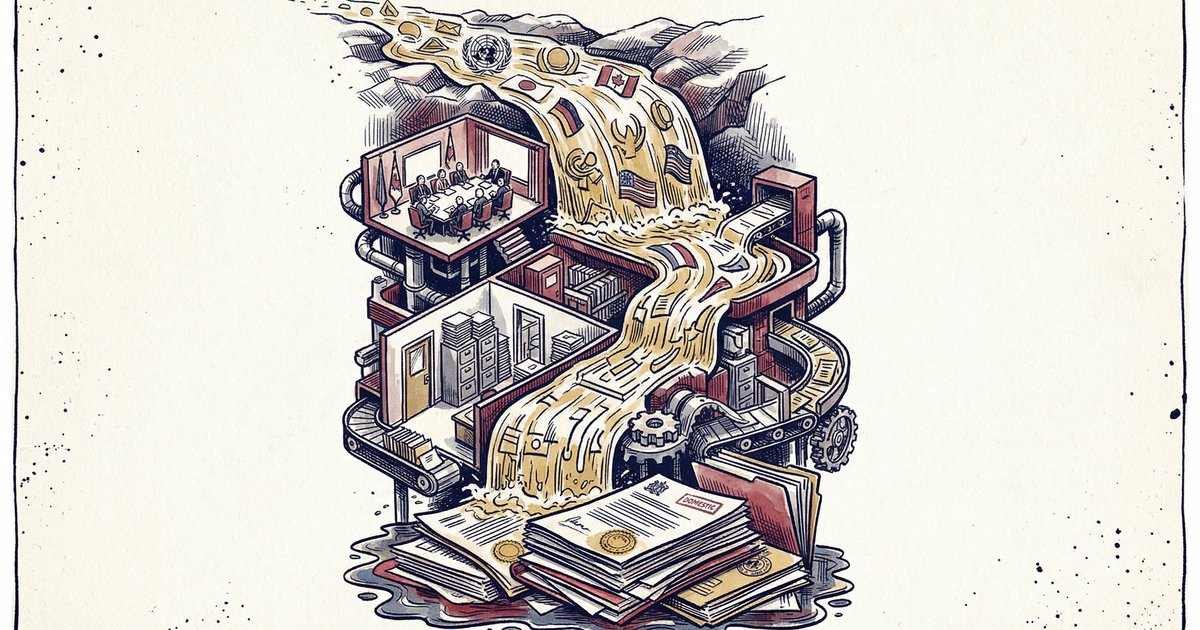
None of this is accidental. Political scientists have described how it works for decades.
Martha Finnemore and Kathryn Sikkink's 1998 paper on norm dynamics describes a three-stage "norm life cycle." First, norm emergence: advocates push a new idea through platforms like the UN. Second, norm cascade: the idea gains legitimacy and adoption accelerates as governments rush to align with what they see as the prevailing position. Third, norm internalization: the idea becomes so embedded in how institutions operate that nobody questions it anymore.
That third stage is where the real power lies. Finnemore and Sikkink describe internalized norms as "extremely powerful and hard to discern." No conscious decision is required. No legislative authorization is sought. The norm is just how things are done.
Michael Barnett and Martha Finnemore's 2004 work on international organizations argues that these bodies are bureaucracies with autonomous authority that "evolve and expand in ways unintended by their creators." They define problems, set agendas, and deploy frameworks that shape domestic implementation — often far beyond what the member states who created them intended.
Shaffer and Pollack (2010) explain the incentive. Binding treaties are expensive — they require interagency coordination, centralized authority, and legislative ratification. Soft law lets governments skip all of that. The bureaucracy naturally prefers the instrument that gives it the most room to move with the least oversight.
Stephen Clarkson developed the concept of Canada's "external constitution" — the web of international agreements and norms that constrain Canadian sovereignty. He argues these are "supraconstitutional" because, unlike normal statutory amendments, they can only be reversed if the external regime itself changes. A domestic legislature can repeal a statute. It cannot unilaterally withdraw from an internalized international norm without significant diplomatic cost. The ratchet turns one way.
Canada's democratic deficit: when the executive governs without Parliament
In theory, Canada's system has a safeguard: treaties need implementing legislation to be enforceable domestically. But treaty-making itself is an executive act — the Prime Minister and cabinet can commit Canada to international agreements without asking Parliament. The 2008 Policy on Tabling of Treaties gives the House of Commons 21 sitting days to consider treaties before ratification, but even that is just a policy, not a law. It can be revoked or bypassed at will.
Joanna Harrington put the problem plainly in a 2005 McGill Law Journal paper: the executive can engage the nation in international legal commitments without involving the institution responsible for making law. With non-binding instruments, the gap is even wider. There is no ratification process, no tabling requirement, no 21-day window. The executive endorses a declaration at an international conference, and the bureaucracy begins implementation.
Alex Neve's 2023 IRPP study identified five impediments to proper implementation of international human rights in Canada, including the gap between executive treaty-making and the legislative implementation that dualism requires but rarely delivers. The study acknowledged that "a misplaced and largely unchallenged assumption has effectively prevailed that the complexities of federalism mean that Canada cannot do better." Canada can do better. The question is whether its institutions are interested in trying.
When bureaucrats decide what the motion really meant
Many of the initiatives described above sound laudable on their face — combatting racism, protecting refugee populations, advancing gender equality, reconciliation with Indigenous peoples. Most Canadians can support these goals in principle.
The problems begin in the gap between a principle expressed in a non-binding motion and the policy apparatus that grows from it.
Mandates creep. The Anti-Racism Secretariat established in response to M-103 began as a time-limited $45 million initiative within Canadian Heritage. It became a permanent institutional feature, migrated to a different department, expanded its scope, and generated a Special Representative with a multi-million dollar budget. A motion condemning Islamophobia became the foundation for a permanent anti-racism bureaucracy with a mandate far broader than what was contemplated when 201 MPs voted yes.
The bureaucracies that implement these mandates are not neutral. They have their own institutional interests, professional cultures, and ideological leanings. When a non-binding motion gives political permission to build, the bureaucracy builds according to its own values — which may or may not represent those of the legislature or the Canadians who elected it. The programs that emerge reflect the priorities of the people staffing the secretariats, shaped by their professional networks and ideological assumptions, not by the considered judgment of Parliament.
The compressed timelines under which these motions are promoted make it worse. Opposition day motions are debated and voted on within a single sitting day. Government motions may receive slightly more floor time but rarely generate the kind of sustained national discussion that legislation requires. Committee studies produce reports that few Canadians read. The government's 120-day response is a bureaucratic document, not a public debate.
By the time the budget allocates funding, the initiative is presented as a fait accompli. The motion passed. The committee studied it. The government responded. The money is in the estimates. Who is left to object?
The left-wing tilt of supranational governance
The norms coming out of the UN system and other supranational bodies lean in a particular direction. They favor expanded state intervention, centralized regulatory frameworks, and collective rights over individual liberty. That is the natural orientation of institutions whose purpose is collective action and whose constituency is governments rather than citizens.
When these frameworks get adopted domestically through administrative channels, they bring an entire philosophy of governance with them — one that tilts toward collectivist and interventionist approaches that may not reflect the preferences of the electorate. GBA+ embeds a particular theory of systemic inequality into every act of governance. The SDGs lay out a comprehensive framework for state-directed social and economic transformation. UNDRIP introduces the concept of free, prior, and informed consent in ways that go beyond what Canadian courts have recognized.
Each arrives with its own vocabulary, its own assumptions, its own institutional logic. And because they are implemented administratively rather than through legislation, none of it gets tested against competing values and priorities in public debate.
If these policies are worth having, they are worth legislating
If these are worthwhile policy objectives, why not pursue them through legislation?
Legislation goes through first reading, second reading, committee study with witnesses and public input, report stage, third reading, Senate review, and Royal Assent. The government has to say what it wants to do, defend that choice against opposition scrutiny, and accept amendments. MPs vote on a specific, binding, enforceable legal text — not a declaration of values. The result is law that courts can review, future Parliaments can amend, and citizens can read and understand.
Orders in Council, while executive instruments, at least derive from statutory authority. They are published, numbered, and subject to parliamentary review through the Standing Joint Committee for the Scrutiny of Regulations.
Non-binding motions and international declarations offer none of these safeguards. They bypass the legislative process and avoid committee scrutiny of the specific policies they generate. They create institutional structures that persist long after the political moment that produced them has passed. Governments build policy without defending it, spend money without authorizing it through dedicated legislation, and create offices without establishing the statutory framework that would define their powers and limits.
What has grown up is a layer of governance that operates between the formal structures of Canadian democracy — below the level of legislation but above the level of ordinary departmental administration. Governance by signal, by budget line, by secretariat, by appointment. Accountable to no one in particular, and very difficult to reverse.
Canadians elect a Parliament to make these choices. Parliament should make them — openly, deliberately, and on the record. If a policy objective is worth pursuing, it is worth legislating. And if it cannot survive the scrutiny of the legislative process, that tells us something important about the policy.
Any conservative running to lead this country, let alone a political party, must commit to uprooting this bureaucratic creep and restoring parliamentary review as the basis for policy. Audit the secretariats and programs created without enabling legislation. Refuse to let international declarations substitute for the hard work of legislating in a democracy.
Go further. Denormalize the practice of values motions in Parliament until new norms are established that prevent their exploitation. When a values motion comes to the floor, the honest response is: if you believe in this, bring a bill. Put it through committee. Let witnesses testify. Let the opposition amend it. Let Canadians see what you are actually proposing to do with their money and in their name. A motion that skips all of that hands a blank cheque to the bureaucracy.
The quiet conversion of symbolic votes into permanent policy needs to be called out and discredited wherever it appears. Canadians did not elect their Parliament to wave through aspirational statements that unelected officials then treat as marching orders. They elected it to govern, openly and accountably.
Related Posts

A special quote for this special Friday
In 1937, Tommy Douglas said the following before Parliament: “Against whom are we arming? What potential aggressor is more aggressive today? Oh, I know that…

Stephen Lewis dead at 88
Stephen Lewis has died at 88. Three generations of the Lewis family have shaped the Canadian left. His passing, days after his son Avi won the NDP leadership,…
Carney to prorogue Parliament after by-elections?
Is Mark Carney set to shutter Parliament after April's by-elections? With a backdoor majority in reach, prorogation would let him dodge accountability for a…