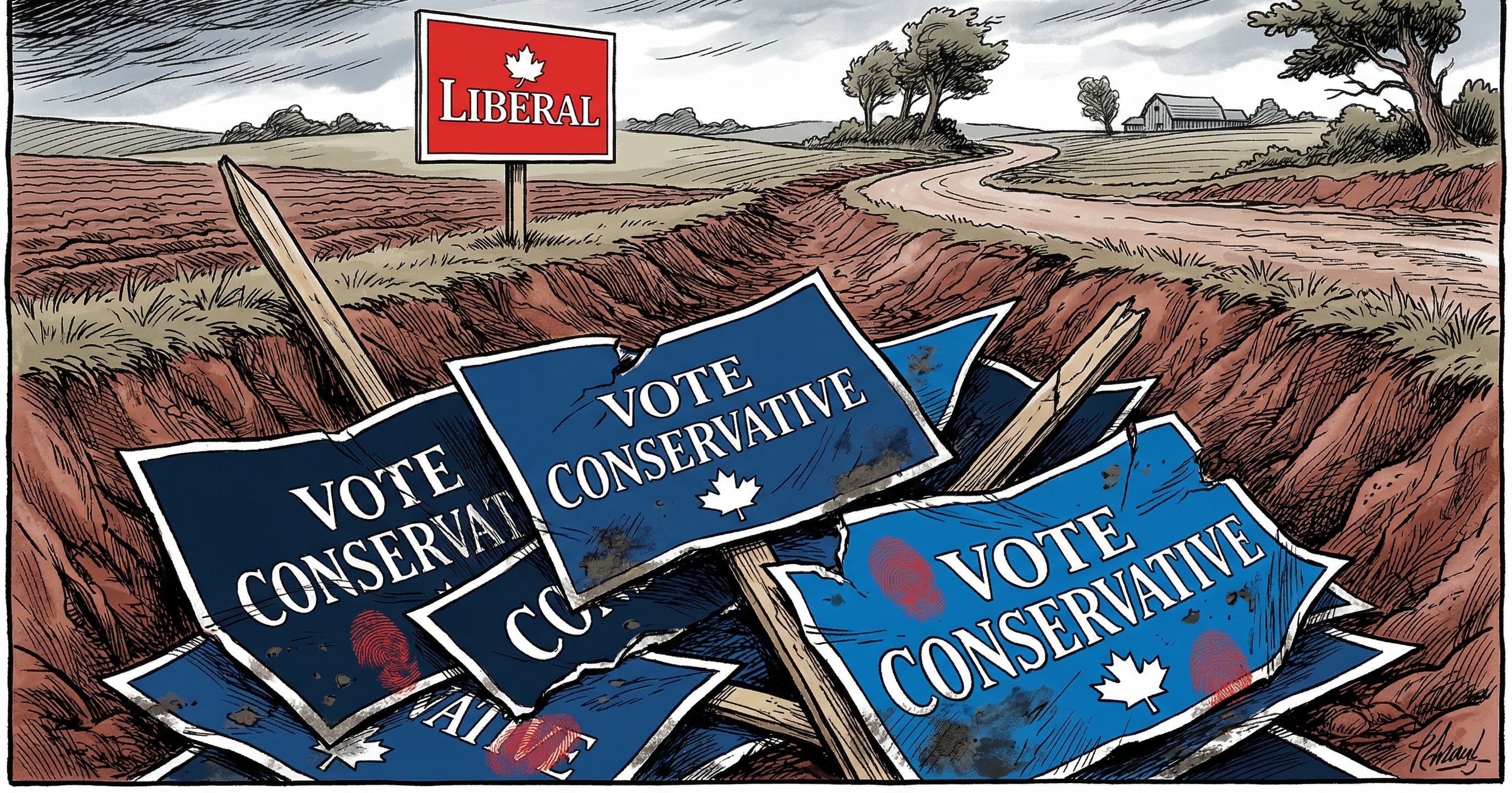
Their website should reflect it. The by-elections are announced on their website in orange and red. These colours are, of course, the colours of the NDP and Liberal Party respectively.
The new name follows criticism over what some considered a partisan remake of the official Government of Canada website, which now has bold splashes of Tory blue and prominently features photographs of Prime Minister Harper.
Of course, Elections Canada is completely separate from any federal ministry and any partisan interference.
Elections Canada used to use yellow to reflect a neutral colour. Why not stick with that model?
Which NDP and Bloc candidate filings are under review by Elections Canada?
Today Marc Mayrand of Elections Canada hinted at the Ethics committee that filings from other parties were also under review by his organization that oversees elections. Currently, Elections Canada claims that the Conservative Party has run afoul of the Elections Act by the shifting of so-called expenses from the national campaign to the local campaigns. However, Elections Canada is only focusing their brutish efforts on the Conservative Party.
I decided to look into this and found that Elections Canada actually discloses via “creative” querying of their database which candidate filings are under review. If we access the contributions and expenses database on the Elections Canada website, we can compare submitted vs. reviewed filings from all candidates. There are discrepancies between both lists suggesting that Elections Canada is actively reviewing a number of filings from candidates of the 2006 General Election.
Data as submitted:
vs. data as reviewed:
Here is the NDP in BC:
Data as submitted:
Data as reviewed:
Nathan Cullen, Libby Davies, and Malcolm James are not on the “data as reviewed by Elections Canada” list while they are on the “data as submitted list”. These NDPers seem to have election filings that are under active review by Elections Canada.
NDP in New Brunswick:
Data as submitted:
Data as reviewed:
Alice Finnamore, Neil Gardner, and Yvon Godin seem to have filings that are under active review by Elections Canada.
NDP in Saskatchewan:
Data as submitted:
Data as reviewed:
Elgin Wayne Wyatt’s name is discrepant between filings submitted to and filings reviewed by Elections Canada suggesting this candidate’s filing is under active review by Elections Canada.
NDP in Ontario:
Data as submitted:
Data as reviewed:
Nirvan Balkissoon, Olivia Chow, Ed Chudak, and Sid Ryan have submitted their filings to Elections Canada but EC has not finished reviewing them meaning they have been flagged for some reason.
NDP in Quebec:
Data as submitted:
Data as reviewed:
Robert Donnelly, Anne Lesvesque, Isabelle Maguire, Ehsan Mohammadian, and Stephane Ricard have not had the reviews of their candidate filings completed by Elections Canada.
NDP in Alberta, Manitoba, Yukon, NWT, Nunavut, PEI, Nova Scotia, Newfoundland and Labrador:
no discrepancy between lists
The Bloc Quebecois only has one candidate from the last election that appears to be under active review by Elections Canada. Diane Bourgeois, according to the EC website, has submitted her candidate filing, however, its review has not been completed.
Over an eight month campaign for the leadership of our party in 2006, in the second biggest country in the world, I spent a little over $2million dollars. Barack Obama spends that amount on his national campaign every day! So I feel – as do all the leadership candidates – that we gave the party and the country a great race, at a very competitive price.
We raised the money on the old rules limiting donations to $5400.00. Now we’re repaying debt following the new rules, which limit contributions to $1100. So it hasn’t been easy, but we’re getting there.
I’ve held fund-raisers across the country and I’m incredibly grateful to all the generous people who contributed sums large and small to enable me to pay off my debt, and to the campaign workers and suppliers who put their faith in me as a candidate. I’ve also raised money for Liberal candidates and MP’s right across the country, as have the other leadership candidates.
My debt started at about $800,000. On June 3, when Elections Canada requires all of the leadership candidates to file returns, I will be reporting the significant progress that I have made with your help. I don’t quite know where I’ll be on that day – some contributions are still in the pipeline or are being processed by the party – but I will not be fully paid off by the deadline. I am within striking distance and expect to pay off the debt completely by the end of the summer.
So, dear friends, if you have not given your maximum of $1100 and still have a generous thought towards me or the other candidates, think of contributing online. Any amount large and small would be appreciated, and remember that you are helping us to keep our promises to all the people who put their faith in us and the party.
Thank you,
Michael
The email ends with a couple of links to his donation page.
What will be the consequences for Michael Ignatieff?
Will Elections Canada provide special treatment for Liberals that run afoul of its rules?
If so, what are the broader consequences for the Conservative Party’s argument that the government body is biased against them?
How much does Ignatieff owe?
Does this indicate that the Conservatives are better at raising money from their membership than the Liberals are? Why are Liberal members disengaged? Why aren’t Liberals giving?
The Elections Canada raid (supporting information and Conservative response)
Below you’ll find the application for a search warrant from Elections Canada (the warrant), attached appendices to the affidavit of EC official Ronald Lamothe, and a list of contradictions that the Conservative Party believes to exist between Lamothe’s affidavit and the supporting documentation.
The Conservative Party has pointed out contradictions that exist between the affidavit sworn and supporting material provided in the appendices to the affidavit. Here are the contradictions that they emphasize (received via email (on the record) from the CPC):
In general, the text of the affidavit is extremely one-sided. It is replete with misstatement, misquote, incomplete quotes, and apparently deliberate omission of information which is contrary to the existence of their “theme” of a “scheme”. A particular concern would be some very serious distortions of the documents that the affidavit purports to paraphrase or refer to.
1. An outrageous example is the fabricated purported quote of Irving Gerstein, Chair of Conservative Fund Canada, contained at p. 54, para 229d. Compare the paraphrased “quote” in the text to the actual email from the person purporting to quote Mr Gerstein, contained at Appendix 25 of the document. The person quoting Mr Gerstein in the email does not say that Mr Gerstein even referred to a “switch” in advertising expenses, let alone that this would be necessary to avoid breaching the limit. The version of the quote in the affidavit is a fabrication by the affiant.
This fabrication undermines the credibility of all the other paraphrased quotes in the affidavit, especially where the quotes are from individuals whose statements are not contained in emails of third parties (as with Mr Gerstein) but rather were allegedly directly made in conversations with the investigators.
2. Another outrageous example is the repeated but baseless implication or innuendo that Party staff essentially fraudulently altered Retail Media invoices (pages 16, 23, 53, 54, 55). This is manifestly false: the explanation is contained at para 79, and reflected in the documents at App 19 and 23. Simply stated, one Retail Media invoice that lists some 40 ridings was obviously re-copied for ease of reference to refer to one riding at a time. The amount applicable to a given riding was unchanged.
3. This baseless implication of fraudulent invoicing is repeated at p. 25, para 92. There is reference to a Retail Media invoice for a riding of $10,657 for “radio”, while it is noted the Party invoice for that riding for “media buy” is $21,240.57. The affiant states that he “is not aware of the reason for the difference”. The reason is that he ignored another Retail Media invoice for the same riding contained at the previous page in the same Appendix (App 8, at pp. 211ff), in the amount of $10,584, for “TV”. The two Retail Media invoices together total $21, 241 – i.e., the same amount as carried forward onto the Party invoice.
4. At p. 25, para. 90, there is a paraphrased alleged quote of an official agent, Lise Vallieres, suggesting that she had never agreed to the advertising expenditure. It is disturbing that there is no reference here to the letter that her candidate sent to Elections Canada dated December 15, 2006 concerning his campaign’s participation in the regional media buy. The letter states as follows:
“Il s’agit d’un ‘placement collectif’ de publicité de plusieurs comtés lors de la dernière election générale (23 janvier 2006). Mme. Lise Vallières, agent officielle du soussigné, a accepté d’y participer de bonne foi.”
(see O’Grady affidavit in Federal Court filing)
5. Anyone familiar with federal electoral law and policy would be aware that every candidate and official agent must sign the following declaration to Elections Canada in relation expenditure listed in their return:
“I hereby solemnly declare that to the best of my knowledge and belief:
“1. the information contained in this return is correct; all election expenses in respect of the conduct or management of the election have been properly recorded;
…
“I make this solemn declaration conscientiously, believing it to be true and knowing that it is of the same force and effect as if made under oath and by virtue of the Canada Evidence Act.”
Yet, there is no reference to this in the several pages of paraphrased quotes from candidates and agents who were interviewed by the investigators.
6. Further, given the repeated implications in the alleged paraphrased quotes that candidates or agents did not enter binding contracts for the advertising, it is unbalanced that there is no reference to the considerable evidence in the emails that Mr Donison dealt directly with many of the local agents or candidates and he stated at the time that he was getting “solemn contractual commitments” from them (see Appendix 47).
7. Also disturbing is the innuendo at p. 54 that Party officials “chose not to seek a ruling…prior to ‘switching’.” The underlying e-mail (Appendix 21) is actually between two people in the media industry, not the Party, who simply discuss whether the Broadcasting Arbitrator should be consulted as to whether they can act as buying agents for local campaigns. There is no mention of “switching”.
Back in November of last year, the Conservative Party filed an affidavit (the “Donald Affidavit”) with the federal court. The document describes similar activities of other federal parties during previous elections and serves to rhetorically ask why the Conservative Party is singled out for what they argue is a common practice. The Conservatives maintain that these transfers for federal/regional/candidate ad buying is legal and that their position is defensible. The party is currently challenging what they argue is the selective misinterpretation of the Elections Act against them by Elections Canada. The Donald Affidavit elaborates on this argument.
This was the CBC’s chief political correspondent Keith Boag’s response to CBC Sunday host Carole McNeil as to why the seasoned journalist and a select few were excluded from a Conservative media briefing on the now famous Elections Canada “visit” at a Sheraton hotel conference room this afternoon.
They say that in this town, it can be more about who you know than what you know. Today, it seems that this is still true.
In less than one week after Boag and camera crew had an exclusive tip-off to show up and film an RCMP investigation (as Boag originally reported), the senior CBC newsman files a frustrated story but fails to speculate on why he doesn’t share the same insider access to CPC news tips that he seems to enjoy from raid tipsters with special knowledge of Elections Canada’s gameplan.
If the Conservative Party of Canada is in the midst of a confrontational legal matter with Elections Canada, isn’t it a bit imprudent for EC to use an enforcement mechanism of the state (the RCMP) to gain leverage (political and informational) against its opponent?
Let’s consider an analogy.
If I was suing Heath Canada for certifying faulty medical equipment that led to personal injury, would it be appropriate for Heath Canada to call in the RCMP to raid my office in order to gather evidence of my claim, decreasing the merit of my case in the eyes of my co-workers (or even the national media if they were called ahead of time). Since Health Canada and I have equal standing in court, would I have the power to leverage this same enforcement mechanism to help my case?
Since Elections Canada has a stake in an ongoing civil action with the Conservative Party of Canada, is conducting their related investigation in conflict with the equal standing that the Conservatives should reasonably expect in their civil case against them?
Furthermore, doesn’t a court in a civil matter have the same powers to gather and secure evidence? So, why is this being done by the RCMP and why is this being directed by one of the stakeholders in a related lawsuit?
Should Elections Canada suspend its investigation process until questions raised by the Conservative Party’s civil suit are sorted out?
Conservatives demand answers on Liberal fundraising scheme
In response to a story broken here three days ago, the Conservatives are demanding answers from Elections Canada on the Grit fundraising auction being held among the 8 Ottawa ridings, where according to the Liberals, “the sky is the limit” and successful bids do not count as donations.
From: Poilievre, Pierre – M.P. [mailto:PoiliP@parl.gc.ca] Sent: Tuesday, February 12, 2008 3:08 PM To: commissionersoffice@elections.ca Subject: “Liberal Party of Canada Cocktail Event” – Investigate
Commissioner of Canada Elections c/o Elections Canada 257 Slater Street Ottawa, Ontario K1A 0M6
February 12, 2008
Dear Sir,
I have become aware of a Liberal Party of Canada Cocktail Event scheduled for February 13th boasts that “the sky is the limit for this auction. A successful bid is not a political contribution…as such individuals, partnerships, corporations and associations are free to bid as high as they want.” The event boasts auction items including:
* Golf with former Liberal Prime Minister Paul Martin. * Attending a hockey game with senior Liberal Member of Parliament and former Liberal leadership contender, Ken Dryden. * Tennis with Liberal star candidate Bob Rae and his brother Liberal campaign Co-Chair, John Rae. * Lunch with Liberal Deputy Leader Michael Ignatieff. * Lunch with former Liberal Prime Minister, Pierre Trudeau’s son, Justin. * Lunch with former Liberal Leadership candidate, Scott Brison
…..and more!
This event raises serious questions surrounding the legality of the fundraising practices of the Liberal Party of Canada. I respectfully ask that you investigate whether or not this event complies with the sprit of the Federal Accountability Act and other federal political party fundraising legislation.
If you allow the Liberal Party to use these methods, you will have unilaterally repealed all of the campaign finance legislation passed over the last five years, and you will be reintroducing big money and corporate cash into our political process.
With the possibly of a federal election happening in the near future I hope that this matter can be dealt with great expediency.
Sincerely,
Pierre Poilievre Member of Parliament Nepean-Carlton
OTTAWA – Today, Member of Parliament Wajid Khan announced he is stepping aside from Conservative caucus. The decision was made following media reports that he may be charged under the Elections Act over matters dating back to the 2004 election, when he ran as a candidate for the Liberal Party.
“Although I have not yet been served with court documents, Given the circumstances, I am withdrawing from the Conservative caucus to sit as an independent MP. I have also offered the Prime Minister my resignation as his Special Advisor for Middle Eastern and South Asian Affairs.”
In and Out common to all parties say Conservatives
The Hill Times had a cover story today describing an affidavit that the Conservative Party filed in Federal Court one week ago today.
The affidavit details examples of so-called in and out election financing by other parties. The HT story included a quote from Tory MP Tom Lukiwski,
In the affidavit, we listed more than 100 individual candidates from all three parties that did the exact same thing that we did in terms of how they entered into an agreement with their national parties on a regional ad buy. So in effect, regardless of the motion of Ms. Redman, we will now be able to take a look at the affidavits that have been presented and I would be fully prepared to bring forward witnesses and all of these candidates from the various parties and have them come forward and have them explain how they entered into this agreement and ask the question that if all parties were doing the same thing why is it that only the Conservative Party was being singled out?
The motion of Ms. Redman, the Liberal whip, was tabled at the Procedure and House Affairs committee asked the committee to investigate “In and Out” financing during the last election. The Conservatives believe that their affidavit shows that all parties participated in the financing practice which allowed individual candidates, in some cases, to participate in regional ad buys.
In discussions with some Conservatives I have heard that there is generally held belief among officials in the party that Elections Canada has been biased in its withholding of $1.2 million of rebates from the Tories. The Conservatives ask rhetorically what the key difference is between their “in and out” financing versus that of the NDP and Liberals. Some Conservatives believe that it is because of party stripe.
I have obtained a copy of the “Donald Affidavit” which describes examples of “in and out” ad buying by other parties.
The Liberals have been trying to make gains from the so-called “In and Out scandal” in which they allege impropriety in the transfers of money from local Conservative election campaigns to the federal campaign for the purposes of funding national advertising.
Transfers of money from local to federal campaigns is of course legal as all parties do this (there is even a category for it on Elections Canada returns that all candidates, EDAs and political parties must file). Indeed, the Conservatives and the Liberals have a different tradition here: The Conservatives send their EDAs 10% of all the money the national party raises, and the Liberals tax their EDAs 40 some percent of their candidate’s Elections Canada refund. However, it is the channeling of local cash to the federal party to pay for advertising where the Liberals see red in the Tories’ blue campaign.
One of the most vocal critics of this alleged scheme has been Liberal MP Marlene Jennings of Notre-Dame-de-Grâce–Lachine. Here is a quote of hers from the House of Commons:
Mr. Speaker, the in-and-out financing scandal implicates at least six Conservative ministers, like the public safety minister and the foreign affairs minister. Their response? Dead silence.
The member for West Vancouver–Sunshine Coast–Sea to Sky Country [Blair Wilson] did the right thing. At the very first hint of any questions about his campaign he stepped aside so he could clear his name.
The independent investigation into the Conservative scheme has not been completed. Will the government demonstrate true leadership and demand resignations from its six ministers?
Let’s take a closer look at Jennings’ 2004 and 2006 Elections Canada filing:
Click to enlarge
and 2006:
Click to enlarge
Jennings’ 2004 election return shows a $300 expense for advertising paid to the Liberal Party of Canada and a $1500 expense for the same paid to “The Federal Liberal Agency of Canada”. The 2006 return shows a $11,206.86 expense for advertising paid to the Quebec wing of the federal Liberal Party.
The Liberals have alleged impropriety in the Conservative practice of transferring money from local campaigns to federal campaign for use by the federal campaign for “advertising”. Here, we see Jennings transferring sums of money to both the federal party and Quebec wing of the federal party for “advertising”. What sort of advertising services did the LPOC and LPOC(Q) provide for Ms. Jennings? It should be noted that Jennings also declared expenses that her campaign paid to her riding association for advertising, so what of these similar expenses paid to national HQ? Did Jennings pay the party to produce Marlene Jennings specific advertising, Quebec regional advertising or national advertising? What is the difference between each of the three if they were paid for by the official agent for Marlene Jennings?
When you look at other Quebec campaigns it appears that more than a few Quebec Liberal candidates including Stephane Dion bought about $11,000 or $4,900 of advertising from the Liberal Party of Canada in Quebec.
Is the LPOC an ad-agency or did they purchase advertising for their candidates like the Conservatives bought for their Candidates?
Of course, in my opinion, no laws have been broken here and if this shows that the Liberals were also involved in a so-called (by them) “In and Out scheme” the only things they are guilty of is hypocrisy.
Furthermore, why was this practice given a green light in the past for the Liberals by Elections Canada when it now raises questions by the federal agency. Are not all parties equal under the law?