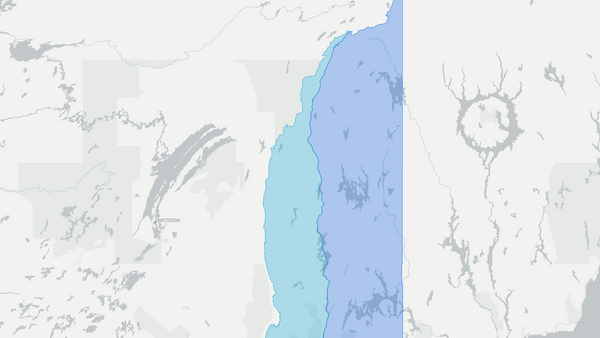
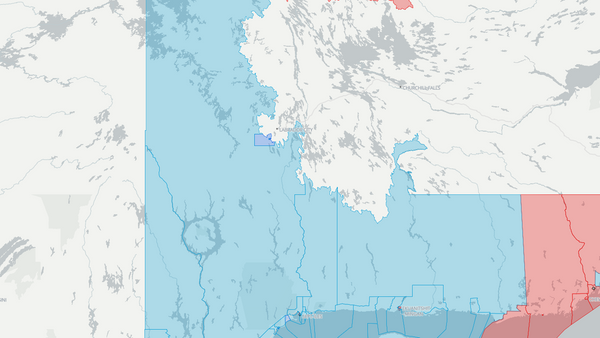
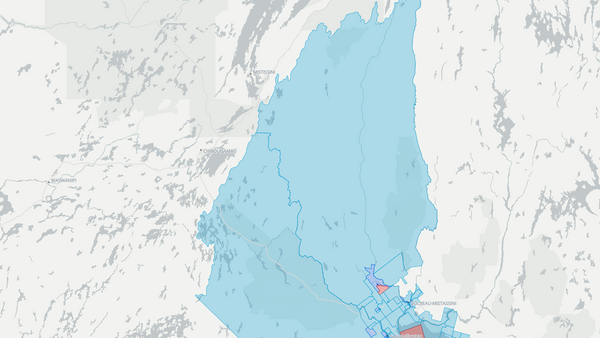
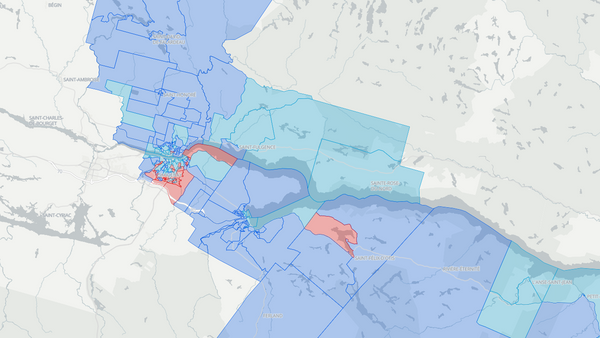
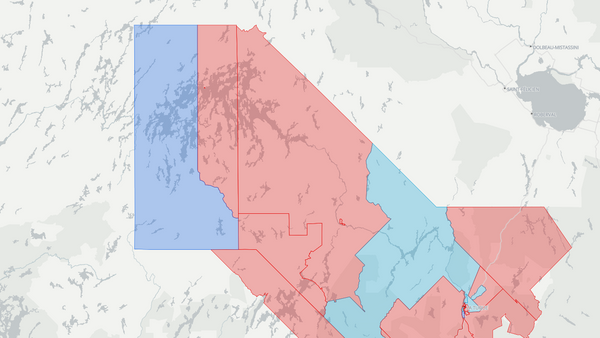
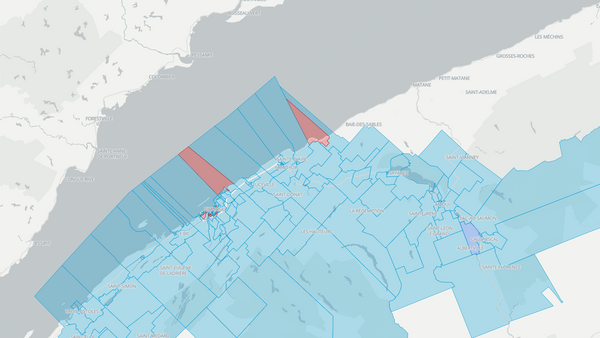
Abitibi—Baie-James—Nunavik—Eeyou, QC — 2025 Federal Election Results Map
Abitibi—Baie-James—Nunavik—Eeyou — 2025 Election Results
📌 The Canadian federal electoral district of Abitibi—Baie-James—Nunavik—Eeyou was contested in the 2025 election.
🏆 Mandy Gull-Masty, the Liberal candidate, won the riding with 12,578 votes (41.2% of the vote).
🥈 The runner-up was Sylvie Bérubé (Bloc Québécois) with 10,381 votes (34.0%), defeated by a margin of 2,197 votes.
📊 Other notable candidates: Steve Corriveau (Conservative, 22%).
Riding information
Auto generated. Flag an issue.Abitibi--Baie-James--Nunavik--Eeyou
Abitibi--Baie-James--Nunavik--Eeyou is the largest federal riding in Quebec by land area, encompassing more than half of the province's total landmass. It stretches from the mining towns of the Abitibi region northward through the boreal forests of James Bay to the Arctic tundra of Nunavik along Hudson Bay and Ungava Bay. The riding is home to roughly 44,000 residents drawn from three distinct populations: francophone settlers in the southern Abitibi corridor, the nine Cree communities of Eeyou Istchee along the eastern shore of James Bay, and the fourteen Inuit villages of Nunavik above the 55th parallel. Approximately 40 percent of the riding's population is Indigenous. The 2025 election marked a historic shift, with the riding electing its first Cree MP and flipping from the Bloc Quebecois to the Liberals.
Candidates
Mandy Gull-Masty (Liberal) is the first Cree woman elected as a Member of Parliament in this riding. Born in Waswanipi in 1980, she holds two bachelor's degrees from Concordia University in political science and public affairs. Gull-Masty served as Grand Chief of the Grand Council of the Crees from 2021 to 2025, making her the first woman to hold that position. During her tenure as Grand Chief, she led initiatives to expand protected lands, advance moose conservation, and revitalize Cree language and culture across Eeyou Istchee. She stepped down from the role in early 2025 to seek the Liberal nomination.
Sylvie Berube (Bloc Quebecois) was the incumbent, first elected in 2019 and re-elected in 2021. Before entering politics, she spent 32 years working in the health-care system, including serving as a director at the Val-d'Or Hospital and as an administrator for the Taxibus public transportation corporation. In Parliament, she served as the Bloc's critic for Crown-Indigenous Relations and vice-chair of the Standing Committee on Indigenous and Northern Affairs.
Steve Corriveau (Conservative) is originally from Val-d'Or and ran in the riding for a second time, having also been the Conservative candidate in 2021. He spent roughly 20 years working in tourism across Africa, Asia, and Europe. His campaign emphasized housing challenges in northern communities and advocated for splitting the riding to give Indigenous populations their own federal representation.
Thai Dillon Higashihara (NDP) ran as the New Democratic Party candidate in the riding.
About the Riding
The riding's vast geography creates enormous challenges for representation and service delivery. Communities are separated by hundreds of kilometres of wilderness, many accessible only by air for much of the year. The Cree communities of Eeyou Istchee -- including Chisasibi, Mistissini, Waskaganish, and Waswanipi -- are governed under the James Bay and Northern Quebec Agreement, one of Canada's first modern land-claim settlements. The Inuit villages of Nunavik, including Kuujjuaq, Inukjuak, and Puvirnituq, face acute housing shortages, food insecurity driven by the extreme cost of shipping goods north, and limited health-care infrastructure.
The southern portion of the riding centres on the Abitibi mining corridor around Val-d'Or and Chibougamau, where gold, copper, and lithium extraction drive the local economy. Hydroelectric development, particularly the La Grande complex operated by Hydro-Quebec, has shaped the region's landscape and its relationship between Indigenous and non-Indigenous communities for decades.
In 2025, housing remained the most urgent issue across all three population groups. Overcrowding in Nunavik and Cree communities has reached crisis levels, with some households sheltering three or four families. The cost of living in remote northern villages, where basic groceries can cost several times the southern price, compounded hardship. Reconciliation, Indigenous self-governance, and equitable access to health care and education services were central themes in a campaign that ultimately produced a landmark result.