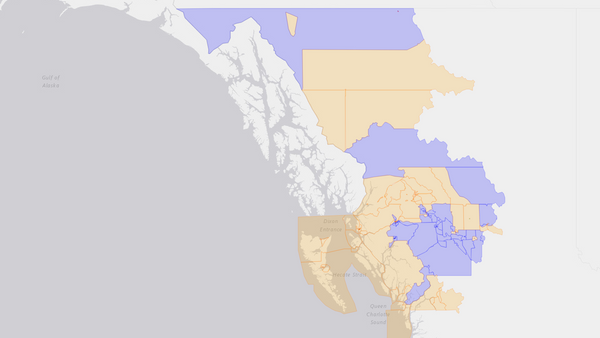
Prince George—Peace River—Northern Rockies, BC — 2021 Federal Election Results Map
Prince George—Peace River—Northern Rockies — 2021 Election Results
📌 The Canadian federal electoral district of Prince George—Peace River—Northern Rockies was contested in the 2021 election.
🏆 Bob Zimmer, the Conservative candidate, won the riding with 29,882 votes (60.7% of the vote).
🥈 The runner-up was Cory Grizz Longley (NDP) with 6,647 votes (13.5%), defeated by a margin of 23,235 votes.
📊 Other notable candidates: Ryan Dyck (PPC, 10%) and Amir Alavi (Liberal, 9%).
Riding information
Auto generated. Flag an issue.Prince George—Peace River—Northern Rockies
Prince George—Peace River—Northern Rockies is one of the largest federal ridings in Canada, spanning the vast interior and northeastern reaches of British Columbia from the northern half of Prince George to the Yukon and Alberta borders. The district encompasses an enormous swath of territory—mountains, boreal forest, river valleys, and prairie-like Peace River country—covering an area larger than many European nations. With a 2021 population of 116,962, the riding's communities are separated by hundreds of kilometres of highway. Major population centres include parts of Prince George (the province's largest northern city), Fort St. John (the hub of northeastern B.C.'s oil and gas sector), Dawson Creek (Mile Zero of the Alaska Highway), Fort Nelson, Tumbler Ridge, Mackenzie, and Chetwynd.
Candidates
Bob Zimmer (Conservative) Born and raised in Dawson Creek and Fort St. John, Zimmer worked as a welder's assistant in the oil industry before becoming a journeyman carpenter and operating a small construction business. He later attended Trinity Western University, where he coached varsity rugby and graduated with a bachelor's degree in human kinetics. First elected in 2011, Zimmer has served as the Conservative critic for Northern Affairs and Arctic Sovereignty and co-chair of the Parliamentary Outdoor Caucus.
Cory Grizz Longley (NDP) Based in Dawson Creek, Longley is a union activist, former radio and television broadcaster, and plumber who was named Dawson Creek's 2007 Citizen of the Year. He previously ran in the riding in 2019.
Ryan Dyck (PPC) A Fort St. John resident and owner of a construction company, Dyck is a father of five who entered the race as a first-time political candidate.
Amir Alavi (Liberal) An immigrant from Iran who arrived in Canada at age 16, Alavi studied psychology at Simon Fraser University and graduated from UBC's Sauder School of Business. He works for a financial institution and has volunteered for over a decade at the Ghadir Community Centre.
About the Riding
The oil and natural gas industry is the economic engine of the Peace River region and the dominant employer across northeastern British Columbia. The Montney Formation, one of North America's most productive shale gas plays, underlies much of the riding east of the Rocky Mountains. Fort St. John and Dawson Creek serve as the logistical and service centres for hundreds of drilling operations, pipeline projects, and processing facilities. The Site C dam—a massive $16 billion BC Hydro hydroelectric project on the Peace River near Fort St. John—was under active construction heading into the 2021 election, employing thousands of workers but also generating controversy over cost overruns and impacts on Indigenous communities and agricultural land.
Forestry is the riding's second major resource industry. Prince George, located at the confluence of the Fraser and Nechako rivers, is home to several pulp mills and sawmills and serves as the primary service centre for British Columbia's central interior. The city is also the site of the University of Northern British Columbia, a research university founded in 1990 that has become a major employer and educational hub for northern residents. Tumbler Ridge, in the Rocky Mountain foothills, hosts significant coal mining operations.
The riding's geographic immensity poses persistent challenges for service delivery. Health care access is a major concern—residents of Fort Nelson, for example, must travel more than 1,200 kilometres to reach Vancouver for specialist care. Highway maintenance and safety along corridors such as the Alaska Highway and Highway 97 are perennial issues. The riding has a significant Indigenous population, including members of the Treaty 8 First Nations whose traditional territories encompass much of the Peace River region, and questions of consultation, land rights, and resource development featured prominently in local political discourse.