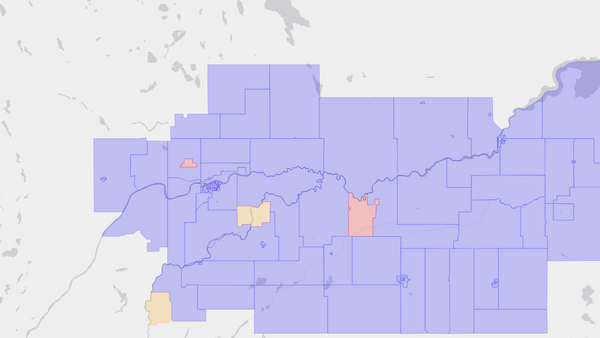
Desnethé—Missinippi—Churchill River, SK — 2021 Federal Election Results Map
Desnethé—Missinippi—Churchill River — 2021 Election Results
📌 The Canadian federal electoral district of Desnethé—Missinippi—Churchill River was contested in the 2021 election.
🏆 Gary Vidal, the Conservative candidate, won the riding with 10,036 votes (48.8% of the vote).
🥈 The runner-up was Buckley Belanger (Liberal) with 5,533 votes (26.9%), defeated by a margin of 4,503 votes.
📊 Other notable candidates: Harmonie King (NDP, 17%).
Riding information
Auto generated. Flag an issue.Desnethé—Missinippi—Churchill River
Sprawling across the northern half of Saskatchewan, Desnethé—Missinippi—Churchill River is the third-largest federal riding situated within a province, covering more than 340,000 square kilometres of boreal forest, Canadian Shield, and subarctic tundra. The riding stretches from communities near Meadow Lake and Prince Albert National Park in the south to the shores of Lake Athabasca and the Northwest Territories border in the north. Major centres include La Ronge, Meadow Lake, and La Loche, but much of the population is dispersed across remote First Nations reserves and northern settlements accessible only by air or winter roads.
Candidates
Gary Vidal (Conservative) — Born and raised in Meadow Lake, Vidal is a Chartered Professional Accountant who co-owned a local accounting practice before entering politics. He served as Mayor of Meadow Lake prior to winning the riding in 2019 with roughly 42 percent of the vote, defeating NDP incumbent Georgina Jolibois. He was the first Conservative to hold this traditionally competitive seat since 2008.
Buckley Belanger (Liberal) — A veteran Saskatchewan politician, Belanger served as MLA for Athabasca from 1995 to 2021—initially under the Saskatchewan Liberal banner before crossing to the provincial NDP in 1998. He resigned his provincial seat in August 2021 to seek the federal Liberal nomination. A Métis leader with deep roots in northern communities, Belanger has spent decades advocating for Indigenous rights and northern infrastructure.
Harmonie King (NDP) — A Métis resident of Meadow Lake and registered social worker, King is a mental-health advocate who had previously run in the Saskatchewan provincial election and in a Métis Nation—Saskatchewan election. Her campaign emphasized gaps in health care—particularly mental-health and addictions services—in remote northern communities.
Dezirae Reddekopp (PPC) — Reddekopp represented the People's Party of Canada, running on the party's platform of reduced government spending, opposition to vaccine mandates, and elimination of the carbon tax.
About the Riding
Desnethé—Missinippi—Churchill River is demographically unique in western Canada. According to the 2021 census, approximately 70 percent of the population identifies as Indigenous—primarily Cree, Dene, and Métis. Cree is spoken by roughly 21 percent of residents and Dene by about 11 percent, making it one of the most linguistically diverse ridings outside the territories. The Lac La Ronge Indian Band, headquartered in La Ronge, is one of the ten largest First Nations in Canada.
The northern economy revolves around mining, forestry, fishing, and trapping. Saskatchewan's uranium mining sector—centred on operations in the Athabasca Basin—generates approximately $500 million per year and employs a significant Indigenous workforce. Forestry operations feed regional sawmills and pulp facilities, while commercial fishing on lakes such as Lac La Ronge and Wollaston Lake provides seasonal employment.
Despite its resource wealth, the riding faces acute challenges in health-care delivery, housing, education, and transportation. Many communities lack year-round road access, and residents often must travel hundreds of kilometres for medical appointments or government services. Boil-water advisories, overcrowded housing, and high rates of food insecurity are ongoing concerns that cross partisan lines.
Electorally, the riding has swung between Conservatives, Liberals, and the NDP over the past quarter-century, making it one of the most competitive seats in Saskatchewan. Voter turnout tends to be lower than the provincial average, a factor that analysts attribute to geographic barriers, limited polling-station access, and the logistical difficulties of campaigning across such an enormous territory.