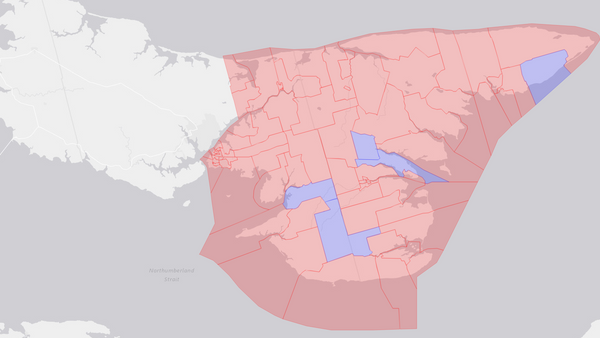
Charlottetown, PE — 2021 Federal Election Results Map
Charlottetown — 2021 Election Results
Poll-by-poll results for Charlottetown in the 2021 Canadian federal election. The Liberal candidate won this riding. Explore detailed voting data, candidate results, and turnout statistics at the poll level.
Riding information
Auto generated. Flag an issue.Charlottetown
Charlottetown is the most urban of Prince Edward Island's four federal ridings, encompassing the provincial capital and its immediate surroundings. The riding is compact at roughly 46 square kilometres and is centred on the city of Charlottetown, which had a population of 38,809 in the 2021 census. As the birthplace of Confederation, Charlottetown serves as Prince Edward Island's seat of government, its commercial centre, and home to its major post-secondary institutions.
Candidates
Sean Casey (Liberal) was first elected in 2011, succeeding four-term incumbent Shawn Murphy. Born in St. John's, Newfoundland in 1963, Casey was educated at St. Francis Xavier University and Dalhousie Law School. He joined the law firm Stewart McKelvey in 1989, became a partner in 1993, and later served as president of the Paderno Group of Companies from 2003 to 2008 before returning to Stewart McKelvey as managing partner. He was president of the P.E.I. Liberal Party from 2003 to 2007. In Parliament, Casey served as Parliamentary Secretary to the Minister of Fisheries, Oceans, and the Canadian Coast Guard, and later as Parliamentary Secretary to the Minister of Justice and Attorney General of Canada.
Doug Currie (Conservative) is a former educator and school principal who served as a Liberal MLA for Charlottetown-Parkdale from 2007 to 2017, holding cabinet posts including Minister of Health and Minister of Education. He holds a Bachelor of Arts and Bachelor of Education from the University of Prince Edward Island and a Master of Education from the University of New Brunswick. After leaving provincial politics, Currie became Vice President of Corporate Services, Strategic Development and Stakeholder Relations at Holland College. He switched from the Liberals to the Conservatives before the 2021 federal campaign and was acclaimed as the Conservative nominee.
Margaret Andrade (NDP) is a community organizer who previously ran as a federal NDP candidate in Leeds—Grenville—Thousand Islands and Rideau Lakes in Ontario in the 2015 election and served on a municipal council in Alberta before moving to Prince Edward Island. She entered the 2018 P.E.I. NDP leadership race and was an advocate for stronger federal representation on issues affecting Islanders.
Darcie Lanthier (Green Party) is an entrepreneur and renewable energy practitioner who serves as president of Solar Island Electric and technical sales manager for Renewable Lifestyles, a solar energy supplier on Prince Edward Island. Her interest in climate policy dates to a 1988 national conference on climate change. Lanthier ran for the Greens provincially in 2011 and 2015, and federally in Charlottetown in 2019, making 2021 her second federal campaign.
Scott McPhee (People's Party of Canada) was born and raised on Prince Edward Island and is trained as a resident care worker. He described himself as a long-time advocate for free speech and mental health awareness, and sought to encourage open discussion on public policy topics.
About the Riding
Charlottetown is the economic, cultural, and administrative heart of Prince Edward Island. As the provincial capital, it hosts the provincial legislature, the offices of the federal and provincial governments, and the national headquarters of Veterans Affairs Canada, which was relocated to Charlottetown in 1983 as part of a federal decentralization initiative. Government at all three levels is the dominant employer in the riding.
The city is home to two major post-secondary institutions: the University of Prince Edward Island (UPEI), founded in 1969 on the former campus of St. Dunstan's University, and Holland College, the provincial community college, whose main campus occupies the former Prince of Wales College downtown. Together they contribute significantly to the local workforce and economy, drawing students from across the Atlantic region and internationally.
Charlottetown's economy has diversified in recent decades. A growing technology sector has increased its share of the city's workforce, with companies in bio-technology, digital media, and software development establishing operations. Light manufacturing in chemicals and machining also contributes to the economic base. Tourism is a major seasonal industry, with Charlottetown's historic waterfront, the Confederation Centre of the Arts, and its role as the "Birthplace of Confederation" attracting visitors throughout the summer months.
The 2021 census recorded that approximately 21.8% of Charlottetown's population identified as visible minorities, reflecting significant immigration-driven growth. Housing affordability and rental availability were pressing issues during the 2021 campaign, as rapid population growth strained the city's housing stock. Health care access—particularly family doctor shortages and wait times—was another top concern among voters. Candidates debated the federal role in addressing these largely provincial challenges, as well as pandemic recovery, support for small business, and investments in public transit and active transportation infrastructure.