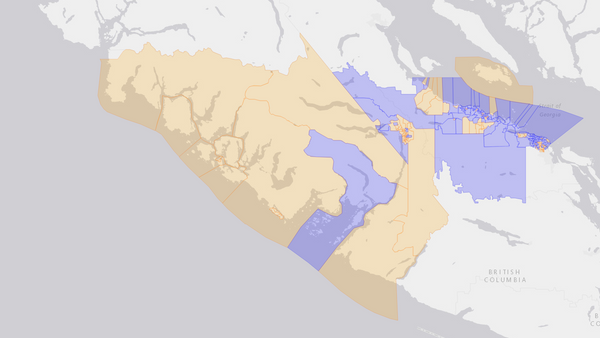
Nanaimo—Cowichan, BC — 2011 Federal Election Results Map
Nanaimo—Cowichan — 2011 Election Results
📌 The Canadian federal electoral district of Nanaimo—Cowichan was contested in the 2011 election.
🏆 Jean Crowder, the NDP-New Democratic Party candidate, won the riding with 31,272 votes (48.9% of the vote).
🥈 The runner-up was John Koury (Conservative) with 24,497 votes (38.3%), defeated by a margin of 6,775 votes.
📊 Other notable candidates: Anne Marie Benoit (Green Party, 8%).
Riding information
Auto generated. Flag an issue.Nanaimo—Cowichan
Nanaimo—Cowichan covered the southern portion of the city of Nanaimo and the Cowichan Valley on Vancouver Island, stretching from Ladysmith and Chemainus through Duncan and Lake Cowichan to Cobble Hill, Shawnigan Lake, and Mill Bay. The riding bridged an urban-suburban coastal strip along the Strait of Georgia with the forested interior of the Cowichan Valley, one of British Columbia’s most ecologically diverse regions. It was home to a significant Indigenous population, centred on the Cowichan Tribes, one of the largest First Nations in the province.
Candidates
Jean Crowder (NDP)* — Crowder was born in Montreal on July 7, 1952, and earned a degree in psychology from Wilfrid Laurier University in Waterloo, Ontario. A human resources consultant and manager by profession, she had worked at Malaspina University-College, Human Resources Development Canada, and the BC Ministry of Skills Training and Labour before entering politics. She served as a councillor in the District of North Cowichan from 2003 to 2004 and was first elected to Parliament for Nanaimo—Cowichan in 2004. She won re-election in 2006, 2008, and 2011, capturing approximately 49 percent of the vote in 2011.
John Koury (Conservative) — Koury was born in Fort St. John in 1964 and had lived in the Cowichan Valley for over thirty years. He held a Master of Business Administration from Royal Roads University and earned the Chartered Director designation from the Directors College at McMaster University. His career included senior executive management and corporate board positions, including serving as General Manager of Logistics Operations at the Forzani Group in Calgary. He later served two consecutive terms on North Cowichan council and chaired the municipal Economic Development Committee for six years.
Anne Marie Benoit (Green Party) — Benoit ran as the Green Party candidate and received approximately eight percent of the vote, finishing third. She described her motivation for running as a desire for public service.
Brian Fillmore (Liberal) — Fillmore was the Liberal candidate in Nanaimo—Cowichan, a riding where Liberal support had fallen sharply in recent elections.
Jack East (Marxist-Leninist) — East ran for the Marxist-Leninist Party of Canada.
About the Riding
Nanaimo—Cowichan was a diverse riding that combined the working-class southern neighbourhoods of Nanaimo with the agricultural and forested communities of the Cowichan Valley. Duncan, the valley’s main town, styled itself the City of Totems and served as a commercial centre for the surrounding area. The Cowichan Valley was renowned for its warm climate, wineries, and artisan food producers, while also supporting a traditional resource economy in forestry and agriculture. Ladysmith and Chemainus, both along the coast, had reinvented themselves as arts and heritage tourism destinations after the decline of their industrial base.
The economy was a mix of forestry, agriculture, tourism, and public sector employment. The Catalyst Paper operations and various sawmills provided industrial jobs, while the Cowichan Valley’s emerging wine industry and farm-to-table movement were driving a new economic identity. Health care and education were major employers, particularly through the Cowichan District Hospital and Vancouver Island University’s Cowichan campus. The riding also included several First Nations reserves, with the Cowichan Tribes representing one of the largest band populations in British Columbia.
Demographically, the riding had a notably high Indigenous population—roughly twelve percent by 2011—which was well above the provincial and national averages. This demographic reality shaped local politics and policy priorities, with Indigenous land claims, treaty negotiations, and social services playing a prominent role in public discourse. The non-Indigenous population was predominantly anglophone, with a mix of retirees, young families, and resource workers.
Politically, Nanaimo—Cowichan was one of the NDP’s strongest seats on Vancouver Island. Crowder had built a reputation as a dedicated constituency MP with particular expertise in Indigenous affairs, serving as the NDP’s critic for Aboriginal Affairs. Her ten-point victory over Koury in 2011 demonstrated the NDP’s resilience in the riding even as the Conservatives won a majority government nationally. The riding’s blend of union workers, First Nations voters, and progressive residents in the arts communities provided a durable coalition for the NDP.