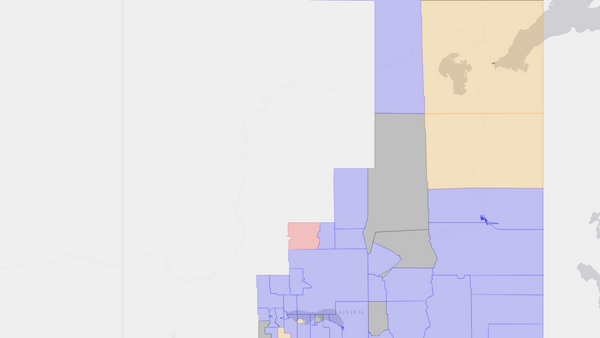
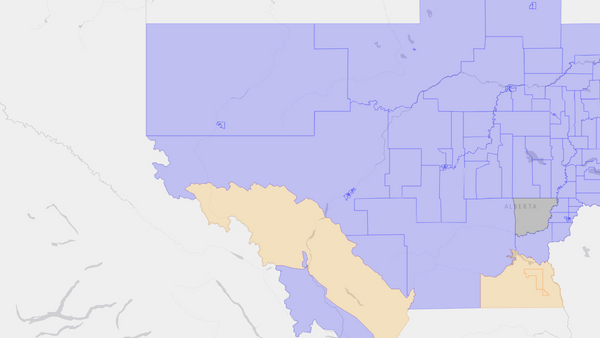
Peace River, AB — 2011 Federal Election Results Map
Peace River — 2011 Election Results
📌 The Canadian federal electoral district of Peace River was contested in the 2011 election.
🏆 Chris Warkentin, the Conservative candidate, won the riding with 35,838 votes (75.5% of the vote).
🥈 The runner-up was Jennifer Villebrun (NDP-New Democratic Party) with 7,740 votes (16.3%), defeated by a margin of 28,098 votes.
Riding information
Auto generated. Flag an issue.Peace River
Peace River was a vast federal electoral district in northwestern Alberta that ranked among the largest ridings in Canada by geographic area. The riding stretched from Grande Prairie and the farming country of the Peace River valley in the south to the remote northern settlements of High Level, Fort Vermilion, and Rainbow Lake near the Northwest Territories border. It encompassed the Peace River Country, a broad agricultural and resource-rich region centred on the town of Peace River at the confluence of the Peace and Smoky rivers, approximately 486 kilometres northwest of Edmonton.
Candidates
Chris Warkentin (Conservative) — Born in Grande Prairie in 1978 and raised on the family farm near the hamlet of DeBolt in the Municipal District of Greenview, Warkentin studied at the Peace River Bible Institute and later took business and marketing courses at Grande Prairie Regional College. Before entering politics, he owned and operated a custom home building company. First elected in 2006, he won re-election in 2008 and again in 2011, and went on to serve as Chair of the Aboriginal Affairs and Northern Development Committee from 2011 to 2015.
Jennifer Villebrun (NDP) — Villebrun was a Métis lawyer from Peace River who brought northern and Indigenous perspectives to the campaign. She had previously run for the Green Party in the 2008 election before switching to the NDP for 2011. She continued her political involvement in subsequent elections, running again for the NDP in later federal contests in northern Alberta.
Wayne John Kamieniecki (Green Party) — Kamieniecki ran as the Green Party candidate in the Peace River riding, representing the party’s environmental platform in a region dominated by resource extraction industries.
Corina Ganton (Liberal) — Ganton carried the Liberal banner in Peace River, running in a riding where the party had minimal support among the predominantly conservative, resource-dependent electorate.
Russ Toews (Independent) — Toews ran as an independent candidate in the Peace River riding.
Donovan Eckstrom (Rhinoceros Party) — Eckstrom represented the satirical Rhinoceros Party, a perennial minor party known for its humorous and absurdist campaign platforms.
About the Riding
Peace River was one of the most geographically expansive ridings in Canada, covering a territory larger than many European countries. The landscape ranged from the parkland and boreal forest of the southern Peace Country to the muskeg and northern boreal wilderness approaching the Northwest Territories border. The Mackenzie Highway, which connected the town of Peace River to High Level and onward to the Northwest Territories, served as the primary transportation corridor through the riding’s northern reaches. Communities were often separated by vast distances, making constituency service and campaign logistics uniquely challenging.
The economy of the riding was driven by resource extraction, agriculture, and forestry. The oil and gas industry was the dominant employer, with conventional drilling operations and the Peace River Oil Sands, Alberta’s third-largest oil sands deposit, providing well-paying jobs throughout the region. Forestry and lumber operations were significant in the boreal zones, while agriculture—particularly grain farming, canola, and cattle ranching—sustained the southern portions of the riding around Fairview, Peace River, and the surrounding municipal districts. The Government of Alberta was also a major employer, with over fifteen provincial departments maintaining offices in the town of Peace River.
The riding’s population was diverse in ways distinct from urban Alberta. Significant Indigenous and Métis communities were scattered throughout the riding, particularly in the northern reaches around High Level and Fort Vermilion. Francophone communities, including St. Isidore east of Peace River, added to the cultural fabric. The overall population was young compared to provincial averages, reflecting the influx of workers drawn by the energy sector.
Politically, Peace River was a Conservative fortress. Chris Warkentin’s victories reflected the near-universal alignment between the riding’s resource-dependent economy and the Conservative Party’s pro-development platform. Issues of particular concern in 2011 included energy sector regulation, road infrastructure connecting remote communities, access to health care and government services in the north, and relations with Indigenous communities whose traditional territories overlapped with resource development areas. The riding was reconfigured ahead of the 2015 election into Peace River—Westlock.