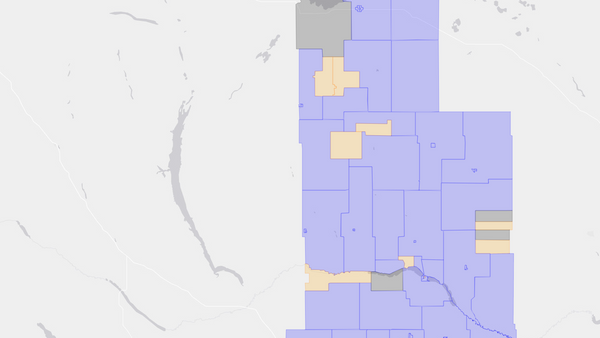
Saskatoon—Humboldt, SK — 2011 Federal Election Results Map
Saskatoon—Humboldt — 2011 Election Results
📌 The Canadian federal electoral district of Saskatoon—Humboldt was contested in the 2011 election.
🏆 Brad Trost, the Conservative candidate, won the riding with 19,688 votes (52.4% of the vote).
🥈 The runner-up was Denise Kouri (NDP-New Democratic Party) with 13,271 votes (35.3%), defeated by a margin of 6,417 votes.
📊 Other notable candidates: Darren Hill (Liberal, 8%).
Riding information
Auto generated. Flag an issue.Saskatoon—Humboldt
Saskatoon—Humboldt was a federal electoral district in central Saskatchewan that combined the northeastern quadrant of the city of Saskatoon with a vast rural territory stretching east to the city of Humboldt and beyond. The riding extended to Quill Lake in the east, Pleasantdale in the northeast, and St. Louis in the north, encompassing the towns of Wakaw, Watson, and Naicam along the way. Covering over 12,000 square kilometres, it was a constituency that bridged Saskatoon's urban neighbourhoods with some of Saskatchewan's most productive farmland.
Candidates
Brad Trost (Conservative) * — Trost holds a Bachelor of Science in geophysics and a Bachelor of Arts in economics, both from the University of Saskatchewan. Before entering politics, he worked as an exploration and mining geophysicist on projects in the Yukon, Northwest Territories, and Nunavut, using electromagnetic tools to help identify mineral drilling targets. Prior to university, he worked at a bakery and helped on the family farm. First elected in 2004, Trost established himself as one of the most outspoken social conservatives in the Conservative caucus, particularly on issues of abortion and same-sex marriage. During the 2011 campaign, he drew national attention by speaking at a Saskatchewan Pro-Life Association convention and urging continued support for defunding Planned Parenthood.
Denise Kouri (NDP) — Kouri was the NDP candidate in Saskatoon—Humboldt and was the only French-speaking candidate in the riding, representing communities with francophone populations. She was active in labour and community organizations and had appeared at the UFCW Canada Saskatchewan Women's Conference. Kouri argued that Saskatoon residents in the riding did not feel represented by Trost's social conservatism, and her campaign was energized by NDP Leader Jack Layton's visit to the riding.
Darren Hill (Liberal) — Hill was a Saskatoon city councillor, first elected to municipal council in 2006, who ran for the Liberal Party in Saskatoon—Humboldt. His municipal experience gave him name recognition in the urban portion of the riding, and he brought a perspective focused on municipal infrastructure and community development.
Sandra Finley (Green Party) — Finley was the former leader of the Green Party of Saskatchewan, serving from 2006 to 2008, and was well known as a privacy and civil liberties activist. She gained national attention for her legal challenge after refusing to fill out the mandatory long-form census in 2006 on Charter grounds, a case that went through multiple levels of court.
Jim Pankiw (Independent) — Pankiw was a former Member of Parliament who had represented Saskatoon—Humboldt from 1997 to 2004, initially as a Reform Party and Canadian Alliance member before sitting as an independent after being expelled from the Alliance caucus. He founded the short-lived Canada Party and ran as an independent in 2011 in an attempt to reclaim the seat.
About the Riding
Saskatoon—Humboldt was one of Saskatchewan's most distinctive ridings, combining a significant urban population base in Saskatoon's northeast with the agricultural communities of the central plains. The Saskatoon portion included residential neighbourhoods that were home to university students, young professionals, and families, while the rural section centred on Humboldt, a predominantly German-Catholic community of about 5,600 that served as a regional hub for surrounding farm communities. The riding's francophone communities, particularly around St. Louis and the historic Batoche area, added cultural diversity.
The economy of the riding was anchored by agriculture in the rural areas, with grain farming and potash mining providing the primary economic drivers. In Saskatoon, the riding's urban residents were connected to the city's broader economy of education, health care, technology, and resource services. The University of Saskatchewan, while not within the riding's boundaries, employed many residents and shaped the character of the adjacent neighbourhoods. Humboldt's economy was closely tied to agribusiness and the service sector supporting surrounding farms.
The 2011 contest was notable for the ideological tensions it highlighted. Brad Trost's unabashed social conservatism—particularly his vocal opposition to Planned Parenthood funding and support for pro-life causes—made the riding a flashpoint in the national debate over the role of social issues in the Conservative Party. His opponents sought to capitalize on discomfort with his positions, but Trost's strong base of social conservative supporters and the Conservative Party's broader popularity in Saskatchewan provided a solid electoral foundation.
The presence of Jim Pankiw as an independent added an unusual dimension to the race. Pankiw had been a controversial figure during his time in Parliament, and his independent candidacy threatened to split votes on the right, though in practice it had minimal impact on the outcome. Trost won re-election with a comfortable margin, as the Conservative wave that delivered Stephen Harper his majority government carried all of Saskatchewan's ridings.